
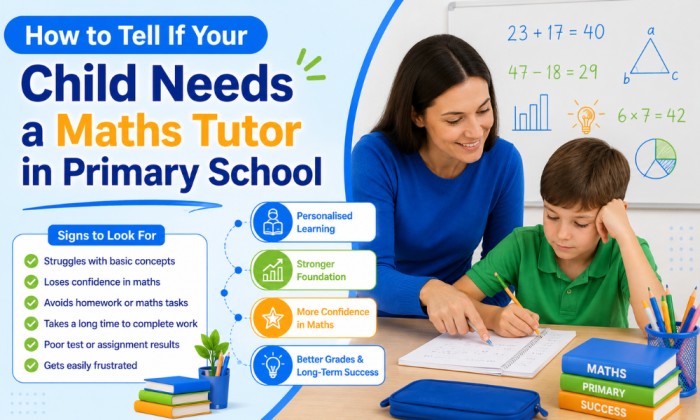
Introduction
Most parents only seek a maths tutor once things have gone wrong. But for many primary school children, the real turning point happens quietly, long before test results raise alarm bells. A child who once enjoyed numbers begins avoiding homework. Confidence dips. What started as a small gap grows into a bigger one. The good news is that early action makes an enormous difference. This article walks you through the genuine warning signs that your primary school child may benefit from one-on-one maths support, what those signs actually mean, and how to take the next step without making maths feel like a bigger deal than it already is.
Why Primary School Is the Critical Window
The maths skills children build in primary school form the foundation for everything that follows. Fractions, multiplication, place value, and basic problem solving are not isolated topics. They are the building blocks for Year 7 algebra, Year 10 geometry, and beyond.
When gaps form early and go unaddressed, children often develop a fixed mindset around maths. They begin to believe they are simply “not a maths person.” Research consistently shows this is rarely true. In most cases, targeted support at the right time resolves the issue completely.
7 Signs Your Child May Need a Maths Tutor
1. They Avoid Maths Homework Entirely
Avoidance is one of the clearest signals a child is struggling. If your child takes 10 minutes to do their reading but an hour of tears to complete a maths worksheet, that pattern is telling you something important. Children avoid tasks that make them feel embarrassed or confused. If the resistance is specifically around maths, it is worth taking seriously.
2. They Cannot Explain Their Working
Ask your child to walk you through how they solved a problem. If they freeze, guess randomly, or simply say “I just know,” it often means they are relying on memory tricks rather than actual understanding. In primary school, understanding the process matters as much as getting the right answer.
3. Teacher Feedback Mentions Maths Gaps
Report cards and parent teacher interviews often contain cautious language. Phrases like “working towards the expected level” or “would benefit from consolidation” are polite ways of flagging that your child is behind. If a teacher has raised concerns, even gently, it is a sign that support outside the classroom would help.
4. Their Confidence Has Dropped
Children who struggle with maths often stop putting their hand up in class. They second guess correct answers. They compare themselves unfavourably to classmates. A drop in confidence is not a personality trait. It is a symptom, and it responds well to the right kind of support.
5. Basic Number Facts Are Still Uncertain
By Year 3 or 4, most children should have quick recall of basic addition and subtraction facts. By Year 5, multiplication tables should feel automatic. If your child is still counting on their fingers in upper primary, or uses a calculator for simple mental arithmetic, it points to a foundational gap that needs attention.
6. They Struggle With Word Problems
Word problems require children to read a situation, identify the maths involved, and apply the right method. If your child can do worksheets but falls apart when a question is presented as a story or real world scenario, they may have gaps in both mathematical reasoning and reading comprehension of maths language.
7. Results Are Declining Despite Effort
Sometimes a child is trying hard but still going backwards. This is genuinely frustrating for the child and the parent. If your child is putting in effort but results continue to slip, it usually means the teaching approach is not clicking for them, not that they are incapable. One on one tutoring allows the method to be adjusted until it actually works.
| Important: You do not need to wait for your child to fail before seeking support. A tutor can be just as valuable for building confidence and preventing gaps from forming as it is for addressing existing ones. |
What About Gifted Children?
Tutoring is not only for children who are behind. Many parents seek a tutor because their child is ahead of the class and becoming disengaged. If your child finds the classroom content too easy and is losing interest, a tutor can provide extension work that keeps them challenged and curious.
This is especially relevant in the lead up to selective school or scholarship testing, where targeted preparation can make a real difference to outcomes.
How to Talk to Your Child About Getting Extra Help
The way you frame tutoring matters. Children pick up on parental anxiety very quickly. If maths has become a source of stress at home, try to separate the emotional weight from the practical solution.
Some approaches that work well:
- Frame it as a skill, not a problem. Explain that lots of people learn maths better with a coach, just like sport or music.
- Keep it low stakes. Avoid attaching tutoring to test scores or school performance in conversations with your child.
- Let them have a say. Ask what kind of support they think might help. Children who feel heard are more receptive.
- Celebrate small wins. Confidence is built through progress, not perfection.
What to Look for in a Primary School Maths Tutor
Not all tutoring is equal. When choosing a Maths tutor for a primary school child, there are a few things worth considering:
- Experience with the Australian curriculum at your child’s year level
- An ability to explain concepts in more than one way
- A teaching style that is patient, encouraging, and age appropriate
- Regular communication with parents about progress
- Flexibility in scheduling with no long term lock in contracts
At Mastering Maths Online, our tutors work one on one with students from Year 1 through Year 12 across all Australian states and territories. Sessions are tailored to each child’s curriculum and learning style, with no lock in contracts so you can start and stop at any time.
Conclusion
Primary school is one of the most important windows for building genuine mathematical confidence. The signs that a child needs extra support are often subtle at first: avoidance, slipping results, a quiet withdrawal from participation. But they are worth acting on early.
Whether your child is falling behind, losing confidence, or simply not reaching their potential, one on one tutoring can make a meaningful and lasting difference. The earlier you address a gap, the easier it is to close.
If you have noticed any of the signs in this article, it is worth exploring your options. A conversation costs nothing, and it could change the trajectory of your child’s confidence and capability in maths for years to come.
Frequently Asked Questions
There is no fixed age, but if you are noticing signs of struggle or disengagement in primary school,. Year 3 and Year 4 are common turning points, as the curriculum becomes more abstract and gaps from earlier years begin to surface. That said, tutoring can be beneficial at any year level from Year 1 through Year 12.
A bad patch tends to pass on its own, often tied to a specific topic or a period of distraction. A genuine gap tends to persist across different topics, gets worse over time, and often comes with a noticeable drop in confidence
Yes, and the evidence continues to grow in its favour. Online tutoring gives children access to qualified tutors regardless of location, removes the pressure of face to face settings that some children find stressful, and allows sessions to happen from the comfort of home.
Most primary school students benefit from one session per week, particularly when the goal is building foundations or closing specific gaps.
Resistance is common, especially if your child associates extra help with being labelled as struggling. Start by framing the sessions positively and making the first session feel low pressure.