
Choosing between HSC Maths Standard and Maths Advanced is one of the most important subject selection decisions a student will make in Year 10. Get it right and your child enters the HSC with confidence. Get it wrong and they spend two years either struggling through a course that is too difficult or holding themselves back from the university pathways they need. This guide explains the real differences between the two subjects, what each course actually requires, how each affects your child’s ATAR score, and how to make the decision that fits your child’s goals and abilities.
What Are HSC Maths Standard and Maths Advanced?
Both subjects are offered in the New South Wales HSC (and equivalent senior secondary certificates in other states). They sit at different levels of difficulty and lead to different outcomes.
Maths Standard 2
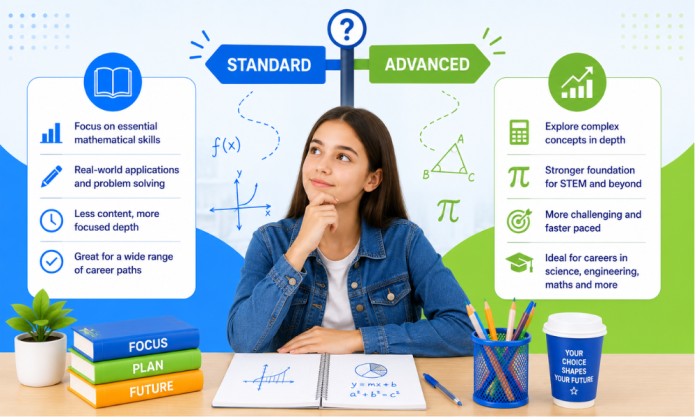
Maths Standard 2 focuses on practical and applied mathematics. Topics include statistics, financial maths, measurement, and networks. The content is designed to give students mathematical skills they can use in everyday life and in a range of careers.
Maths Advanced
Maths Advanced goes deeper into abstract and theoretical mathematics. It introduces calculus, complex algebra, trigonometry, and statistical analysis at a higher level. This course is the foundation for Extension 1 and Extension 2 Maths, and is required for many university degrees.
Key Differences at a Glance
The table below compares both courses across the factors that matter most to families:
| Year 11 Prerequisites | Maths Advanced | Maths Standard 2 |
| Algebra | Strong required | Basic level fine |
| Geometry | Strong required | Basic level fine |
| Calculus in HSC | Yes (core topic) | No |
| University pathways | Engineering, Science, Commerce, Law | Health, Education, Business, Arts |
| ATAR contribution | Higher potential scaling | Lower scaling, still valuable |
| Difficulty | High | Moderate |
| Typical student | Strong Year 10 background | Solid but not top-tier foundation |
Who Should Choose Maths Advanced?
Maths Advanced suits students who:
- Achieved strong results in Year 9 and Year 10 maths (consistently above 75%)
- Enjoy working with abstract concepts and problem solving
- Plan to study engineering, science, IT, economics, commerce, or medicine at university
- Are considering Maths Extension 1 or Extension 2 as additional subjects
- Are comfortable with algebra and can handle multi-step problems independently
| Expert tip If your child is on the borderline, ask their Year 10 maths tutor directly. Teachers see how students perform under exam conditions and can give an honest read on whether Advanced is a realistic choice or an unnecessary risk. |
Who Should Choose Maths Standard?
Maths Standard 2 suits students who:
- Have found maths challenging at times in Years 9 and 10
- Do not intend to study science, engineering, or mathematics-heavy university courses
- Want to focus their energy on subjects where they can achieve higher marks overall
- Plan to pursue careers in health, education, business, arts, or trades
- Would rather build confidence with applied maths than risk falling behind in Advanced
Standard 2 is not the easy option. Students who choose it because they think it requires less effort often find themselves underprepared. It still demands regular study and a solid understanding of foundational maths.
How Does Each Course Affect the ATAR?
This is where families often have the biggest questions. Here is what you need to know.
Scaling
HSC subjects are scaled relative to how students in that subject perform compared to other subjects. Maths Advanced typically scales higher than Maths Standard because the student cohort taking Advanced is generally stronger academically. This means a student who scores 70 in Advanced may receive a higher ATAR contribution than one who scores 80 in Standard.
The real risk
Scaling only helps if your child can perform well in the course. A student who struggles in Maths Advanced and scores in the 50s will likely receive a lower ATAR contribution than a student who excels in Standard and scores in the 80s or 90s.
| The bottom line on ATAR The right course for your child’s wis the one where they can genuinely perform well. A high mark in Standard beats a low mark in Advanced every time. |
University Prerequisites: What Do Degrees Actually Require?
Some degrees require Maths Advanced as a prerequisite or an assumed level of knowledge. Before finalising your child’s subject selection, check the entry requirements for the degrees they are considering.
Degrees that commonly require or assume Maths Advanced (or higher):
- Engineering (all fields)
- Computer Science and Software Engineering
- Physics and Chemistry
- Actuarial Studies
- Economics and Finance at some universities
Degrees where Maths Standard is accepted or no maths prerequisite applies:
- Nursing and Allied Health
- Education (Primary and Secondary)
- Psychology and Social Work
- Business Administration
- Arts, Humanities, and Law (in most cases)
Always check the specific university’s admission requirements, as they vary. ATAR Notes and UAC (Universities Admissions Centre) are both good resources for this.
Can Students Switch Between Courses?
In most cases, it is possible to move from Advanced to Standard in Year 11 if a student is struggling. Moving the other way is harder because Standard does not cover some of the foundational content that Advanced builds on from early Year 11.
If your child is unsure, starting in Advanced and monitoring progress in the first term is a reasonable approach. But the switch should happen early if needed. Waiting until mid Year 11 makes the transition much harder.
How Tutoring Can Help With Either Course
Whether your child chooses Standard or Advanced, many students benefit from targeted support outside school. A good maths tutor can:
- Identify gaps in foundational knowledge before they become bigger problems
- Help students build confidence with topics they find difficult
- Provide exam technique and structured practice with past HSC papers
- Keep students on track when school pace moves quickly
At Mastering Maths Online, we work with HSC students across both Maths Standard and Maths Advanced. Our tutors understand the NSW syllabus and tailor sessions to what each student actually needs.
Conclusion
There is no universally right answer between HSC Maths Standard and Advanced. The decision depends on your child’s current ability, their university goals, and how much they are willing to invest in the subject over two years.
Students who have a genuine aptitude for maths and need it for their future study should pursue Advanced. Students who find maths challenging or who are headed toward careers that do not require it should choose Standard and focus their energy on subjects where they can shine.
If you are still unsure, speaking with your child’s current maths teacher is the most practical first step. A short chat with an experienced HSC tutor can also help you assess where your child actually sits and what is realistic for them.