
If your child is choosing VCE subjects or already deep into Units 3 and 4, you have probably heard the word scaling thrown around, often followed by confident claims about which subjects are worth more. Here is the simple truth. VCE scaling is the process VTAC uses to make study scores from different subjects fairly comparable, so a strong result in a competitive subject is not undervalued next to a strong result in a less competitive one. It does not reward or punish a subject for being hard. It reflects how the students in that subject performed everywhere else. Understanding how scaling works helps families make smarter subject choices and keeps expectations realistic heading into Year 12.
What Is VCE Scaling?
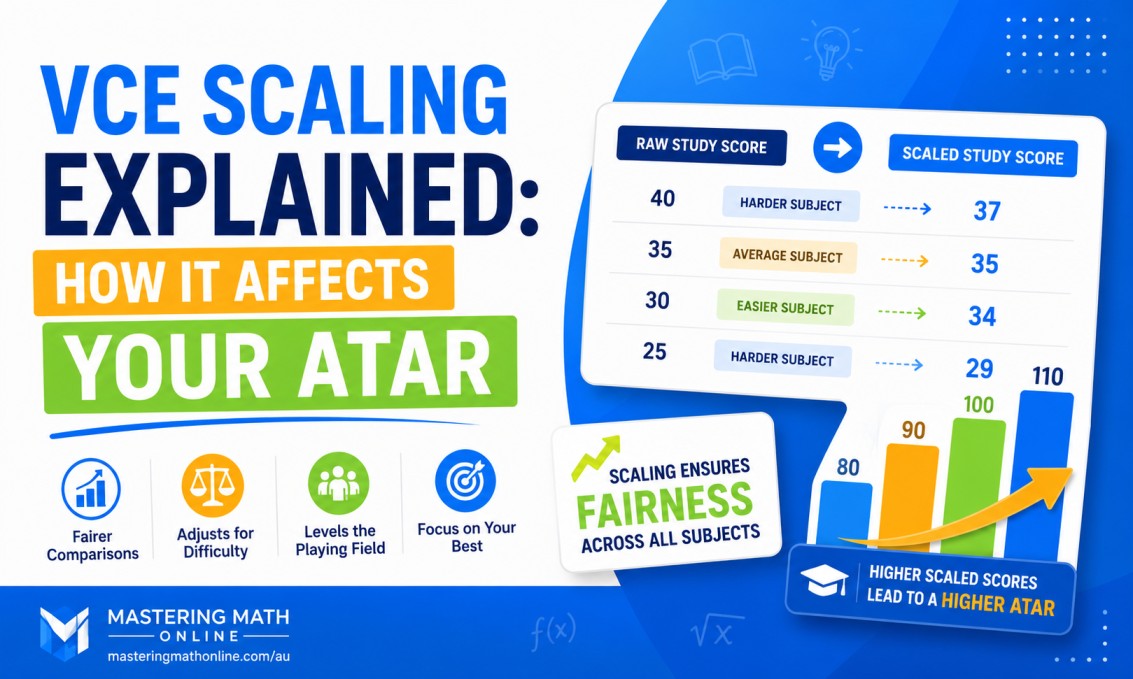
Every VCE subject produces a raw study score between 0 and 50, set by VCAA from a student’s School Assessed Coursework and final exam. The average study score in every subject is standardised to 30, with a spread of roughly 7 marks either side. On its own, that raw study score only tells you how a student performed relative to other students in that same subject.
The problem is that different subjects attract different cohorts. A study score of 35 in a subject taken mostly by strong all-round students is a different achievement to a 35 in a subject with a broader mix of ability. VTAC’s scaling process adjusts each study score so that a scaled 30 in any subject represents the same overall academic achievement as a scaled 30 in any other. That adjusted number is called your scaled study score, and it can run from 0 up to 55.
Why Scaling Exists
Universities need one fair way to compare students who have studied completely different combinations of subjects. Without scaling, a student who chose a combination of easier subjects could end up with a higher aggregate than a student who took on genuinely demanding subjects and did just as well, or better, relative to their peers.
Scaling adjusts for the strength of the cohort sitting each subject, based on how those same students performed across all their other subjects. It has nothing to do with how the subject is taught or how difficult the content feels. It is entirely about the group of students doing the comparing.
How VTAC Calculates Your Scaled Score
Step 1: The Study Score
- Set by VCAA from SAC results and the final exam.
- Ranges from 0 to 50, with 30 as the average for every subject.
- A study score of 40 typically places a student in the top 9 percent of that subject’s cohort.
Step 2: The Scaling Adjustment
- VTAC looks at how the students in a subject performed across all their other VCE studies.
- If that group performed strongly overall, the subject is considered highly competitive and scores are adjusted upward.
- If the group performed more modestly overall, scores are adjusted downward.
- This calculation is run fresh every single year, so scaling is never fixed or guaranteed.
How Scaling Feeds Into Your ATAR
Your ATAR is not simply your average scaled score. It comes from a specific aggregate formula that VTAC then converts into a percentile rank from 0.00 to 99.95.
The Aggregate Formula
- Primary four: your English or EAL scaled score, plus your next three best scaled scores, all counted in full.
- Increments: 10 percent of your fifth and sixth best scaled scores, added as a bonus.
Because your top four subjects carry all the weight, a five point difference in one of those subjects moves your aggregate by five points. The same five point difference in a fifth or sixth subject only moves it by half a point. This is why chasing a marginal scaling benefit in a subject you are not genuinely strong in rarely pays off.
Which Subjects Tend to Scale Up or Down
Scaling increments shift every year depending on that year’s cohort, so treat any list as a general guide rather than a guarantee. That said, some patterns are consistent from year to year.
- Typically scale up: Specialist Mathematics, VCE Mathematical Methods, and several language subjects, which tend to attract academically strong cohorts.
- Roughly neutral: subjects like Biology and Chemistry, where scaling adjustments are usually small.
- Typically scale down: General Mathematics and Foundation Mathematics, along with a small number of other subjects with broader cohorts.
VCE Mathematics has an extra rule worth knowing. All four maths studies are scaled against each other as well as against every other subject, and the higher of the two resulting scales is applied. This protects students taking the more demanding maths pathways.
| A Word of Caution on Chasing Scaling VTAC is explicit about this. A student who picks a subject purely because it scales up, but who is not genuinely capable in it, will usually end up with a lower raw study score and a lower scaled result than if they had chosen a subject they were actually strong in. Scaling only ever multiplies a good result. It cannot rescue a weak one. |
How to Use Scaling Sensibly in Subject Selection
- Choose subjects your child is genuinely capable of doing well in first, and treat scaling as a secondary factor.
- Check the current year’s VTAC Scaling Report rather than relying on figures from previous years.
- Remember that a strong study score in a subject that scales down almost always beats a mediocre score in a subject that scales up.
- Keep prerequisite subjects for university courses in mind before making scaling-driven swaps.
- Build genuine skill early. A student who is confident and consistent by the start of Unit 3 has far more room to achieve a high study score, regardless of how that subject scales.
Conclusion
VCE scaling can feel like a mysterious barrier standing between your child and a strong ATAR, but the mechanics are actually straightforward once explained. Scaling simply makes sure that a strong result in a competitive subject is not undervalued next to a strong result elsewhere. It rewards genuine performance, not clever subject picking. The most reliable path to a great ATAR is still the same one it has always been: choose subjects your child is capable of and interested in, build a strong understanding early, and let consistent, well-supported preparation do the heavy lifting. At Mastering Maths Online, our tutors help VCE students strengthen their understanding in Mathematical Methods, Specialist Mathematics, and General Mathematics so they can achieve the study scores that scaling then works in their favour, rather than trying to out-guess the system.
Frequently Asked Questions
No. Scaling adjusts scores after they are set, based on the strength of the subject’s cohort. It has nothing to do with how strictly a subject is marked.
No. A high scaled score only happens on top of a genuinely strong study score. Choosing a subject purely for scaling, without the ability to do well in it, usually backfires.
Yes. VTAC recalculates scaling every year based on that year’s cohort, so figures from a previous year are a guide only, not a guarantee.
Up to six. Your best four scaled scores count in full, and your fifth and sixth best each contribute 10 percent as increments.
It is usually one of the highest scaling subjects because of its strong cohort, but exact increments shift each year. Check the current VTAC Scaling Report for precise figures.