
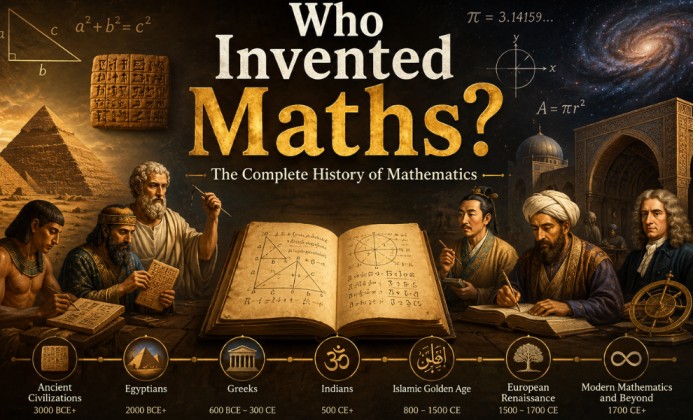
No single person invented maths. Mathematics developed gradually over tens of thousands of years across many different cultures and civilisations — including the Babylonians, Egyptians, Greeks, Indians, and Arabs. Each group built upon the discoveries of those who came before them. Today, we use a system of numbers that is a combination of ideas from India, the Arab world, and Europe.
Maths Wasn’t Invented by One Person
Many students — and adults! — assume that one brilliant person sat down one day and invented mathematics. The truth is far more interesting. Maths grew slowly and organically out of practical human needs: counting animals, measuring land, tracking the stars, and trading goods.
Think of it like language. No one person invented English. It evolved over centuries, borrowing words and ideas from many different peoples. Maths is the same. Different civilisations contributed different pieces of the puzzle, and together they built the subject we study today.
💡 Think of it this way: Maths is like a giant jigsaw puzzle. The Babylonians found some pieces, the Greeks found more, the Indians added others, and the Arabs helped put them all together. We’re still discovering new pieces today!
Prehistoric Maths — 40,000 Years Ago
Believe it or not, the story of maths begins long before writing was even invented. Our ancient ancestors understood numbers because they had to — to count food, track days, and understand seasons.
The Ishango Bone (20,000+ Years Old)
One of the most remarkable artefacts in the history of mathematics is the Ishango Bone, discovered near the Nile River in what is now the Democratic Republic of Congo. This baboon bone, estimated to be over 20,000 years old, has a series of carved marks arranged in three columns. Many historians believe these marks show the earliest known record of number sequences, and possibly even a lunar calendar.
🦴 Did You Know?
The Ishango Bone may show the earliest known sequence of prime numbers — numbers only divisible by 1 and themselves (like 2, 3, 5, 7, 11…). If true, ancient humans were thinking about advanced maths nearly 20,000 years before the first school was built!
Neanderthals and Basic Maths
Even more astonishing: archaeological evidence suggests that Neanderthals — a close cousin of modern humans who lived around 40,000 years ago — may have understood basic mathematical concepts. Researchers found knotted yarn at a site in southern France, suggesting knowledge of patterns and counting.
This tells us something profound: the instinct for mathematics is deeply human. We are, by nature, mathematical creatures.
Babylon & Egypt — The First Written Maths (3000 BC)
Around 3000 BC, something remarkable happened. As civilisations grew in Mesopotamia (modern-day Iraq) and Egypt, people needed a way to record numbers and calculations. This is when written mathematics was born.
Babylonian Maths
The Babylonians used arithmetic, algebra, and geometry for taxation, trade, and astronomy. They worked in base 60 — which is why we still have 60 seconds in a minute and 60 minutes in an hour!
Egyptian Maths
Egyptians used maths to build the pyramids, measure land after Nile floods, and track the calendar. The Rhind Mathematical Papyrus (c. 1800 BC) is one of the oldest maths textbooks ever found.
Pythagorean Triples
Both the Babylonians and Egyptians knew about what we now call the Pythagorean theorem — centuries before Pythagoras was even born! This shows maths was discovered independently in many places.
What Did They Actually Calculate?
Ancient maths was incredibly practical. Babylonian and Egyptian mathematicians calculated things like:
- How much grain was needed to feed an army
- How to divide land fairly among farmers
- How to track the movement of the sun, moon, and planets
- How to collect taxes from citizens
- How to construct buildings with right angles
In other words, maths was invented because people needed it. It wasn’t abstract theory — it was a practical tool for running a civilisation.
Ancient Greece — Maths Gets Logical (600–300 BC)
If the Babylonians and Egyptians were maths users, the ancient Greeks were maths thinkers. The Greeks didn’t just want to know what the answer was — they wanted to know why it was true. This led to one of the most important ideas in mathematical history: the proof.
The Greeks turned maths from a collection of useful tricks into a logical, reasoned discipline. This is why the word “mathematics” itself comes from the ancient Greek word mathema, meaning “subject of instruction.”
Thales of Miletus — The First Mathematical Theorems (600 BC)
Often considered the first mathematician to use deductive reasoning, Thales proved basic geometric theorems. He was the first person to ask “why?” instead of just “what?”
Pythagoras — Numbers Are Everything (570 BC)
Pythagoras and his followers believed numbers were the fundamental nature of reality. His famous theorem about right-angled triangles (a² + b² = c²) is still taught in every school worldwide.
Euclid — The Father of Geometry (300 BC)
Euclid’s book Elements laid out the rules of geometry so clearly and logically that it was used as a textbook for over 2,000 years. His method of building on basic axioms is still how maths is taught today.
Archimedes — The Greatest Mathematician of Antiquity (287 BC)
Archimedes calculated pi (π), developed early ideas of calculus, and invented formulas for areas and volumes. Many historians call him the greatest mathematician of the ancient world.
India — Zero, Decimals & Algebra (200 BC–700 AD)
India’s contribution to mathematics is absolutely enormous — and often underappreciated. Without Indian mathematicians, the number system we use today simply wouldn’t exist.
Aryabhata (476–550 AD)
Indian Mathematician & Astronomer
Aryabhata calculated the value of pi (π) to four decimal places and correctly explained that the Earth rotates on its axis. He made major contributions to algebra and trigonometry.
Brahmagupta (598–668 AD)
Indian Mathematician
Brahmagupta was one of the first mathematicians to formally define and use zero as a number. He created rules for adding, subtracting, multiplying, and dividing with zero — rules we still follow today.
🔢 The Number System We Use Today
The digits 0–9 that the whole world uses today are called Hindu-Arabic numerals. They were invented in India and later spread to Europe through Arab mathematicians. Before this system, Europeans used clunky Roman numerals (I, V, X, L, C…) which made large calculations extremely difficult!
The Islamic Golden Age — Algebra & Algorithms (700–1200 AD)
Between roughly 700 and 1200 AD, the Islamic world became the centre of mathematical knowledge. Arab and Persian scholars translated ancient Greek and Indian texts, preserved them, and — most importantly — extended them with brilliant new discoveries.
Muhammad ibn Musa al-Khwarizmi (c. 780–850 AD)
Persian Mathematician — “The Father of Algebra”
Al-Khwarizmi wrote a groundbreaking book called Al-Kitāb al-mukhtaṣar fī ḥisāb al-jabr wal-muqābala. The word “al-jabr” in its title gave us the word algebra. His name, Latinised as “Algorismus,” gave us the word algorithm — a term central to modern computing and artificial intelligence!
Islamic scholars also preserved the works of Euclid, Archimedes, and other Greek mathematicians during a period when much of this knowledge was at risk of being lost in Europe. Without them, we might have had to rediscover centuries of mathematical progress.
Europe’s Mathematical Revolution (1400–1700 AD)
Starting in the Renaissance period (around the 1400s), Europe began an extraordinary mathematical awakening. New ideas, new tools, and a new spirit of scientific inquiry led to some of the greatest breakthroughs in history.
✖️ – Negative Numbers
While Indian mathematicians had worked with negative numbers earlier, European mathematicians in the 1500s formally accepted and developed their use.
📊 – Probability
In the 1600s, French mathematicians Blaise Pascal and Pierre de Fermat invented probability theory — the maths of chance — while analysing gambling games!
∫ – Calculus
Isaac Newton and Gottfried Leibniz independently invented calculus in the 1600s — powerful tools for understanding motion, change, and the natural world.
💹 – Coordinate Geometry
René Descartes combined algebra and geometry, creating the coordinate plane (the x-y grid). This is why it’s called the Cartesian plane — named after him!
🍎 Fun Fact: Isaac Newton reportedly came up with ideas about gravity and calculus while stuck at home during the plague of 1665–1666 — an early example of productive isolation! The pandemic gave him time to think, and he used it to change the world.
Modern Mathematics — 1700 to Today
From the 1700s onwards, mathematics exploded in complexity and scope. New fields were invented, old ones were deepened, and maths became the essential language of science, engineering, economics, and technology.
1700s – Leonhard Euler — The Most Prolific Mathematician Ever
Euler made major contributions to calculus, graph theory, number theory, and mechanics. He introduced much of the notation we use today, including the use of π for pi and i for imaginary numbers.
1800s – Carl Friedrich Gauss — The “Prince of Mathematics”
Gauss made profound contributions to number theory, statistics, and geometry. His work on the normal distribution (the “bell curve”) is fundamental to modern statistics and data science.
1900s – Alan Turing — Maths Meets Computing
British mathematician Alan Turing laid the theoretical foundations of computer science, creating concepts that led to the modern computer. Every device you use today exists partly because of his mathematical ideas.
Today – Maths is Still Being Invented
Mathematicians are still discovering entirely new areas of maths. Fields like cryptography (used in online banking), machine learning (used in AI), and quantum computing are all active areas where new maths is being created right now.
Key People Who Shaped Mathematics
While no single person invented maths, these individuals made contributions so significant that the story of mathematics cannot be told without them:
🏛️ Euclid (c. 300 BC)
Father of geometry. His textbook Elements was used for 2,000 years.
⚙️ Archimedes (287–212 BC)
Calculated pi, invented early calculus concepts, greatest ancient mathematician.
🔢 Brahmagupta (598–668 AD)
Formally defined zero and created rules for calculating with it.
📝 Al-Khwarizmi (780–850 AD)
Invented algebra and gave us the word “algorithm.”
🍎 Isaac Newton (1643–1727)
Co-invented calculus; transformed physics and astronomy.
💻 Alan Turing (1912–1954)
Mathematical foundations of computing and artificial intelligence.
What Does This Mean for Students Today?
Understanding the history of maths helps us appreciate something important: maths is a human achievement. It wasn’t handed down from some higher power — it was figured out by real people, often with great difficulty, over thousands of years.
When a student struggles with algebra, they’re wrestling with the same ideas that stumped some of the greatest minds in history. And when they finally understand it, they’re joining a 4,000-year-long tradition of human problem solving.
At Mastering Math Online, our qualified tutors help Australian students connect with maths in a way that makes sense — building real understanding, not just memorised formulas. Whether your child is in Year 1 or Year 12, learning maths is learning to think — and that skill lasts a lifetime.
Frequently Asked Questions
No single person invented maths — it was developed over thousands of years by many civilisations including the Babylonians, Egyptians, Greeks, Indians, and Arabs.
The earliest evidence of maths dates back over 20,000 years, with formal written mathematics beginning around 3000 BC in Babylon and Egypt.
Archimedes of Syracuse (287–212 BC) is widely regarded as the father of mathematics for his groundbreaking work in geometry and early calculus concepts.
Zero was formally developed in India by the mathematician Brahmagupta (598–668 AD), who also created the rules for calculating with it.
Muhammad ibn Musa al-Khwarizmi, a 9th-century Persian mathematician, invented algebra — and his name even gave us the word “algorithm.