
What Is the Australian Curriculum?
The Australian Curriculum is a national education framework developed by the Australian Curriculum, Assessment and Reporting Authority (ACARA). It sets out the knowledge, understanding, and skills that all Australian students are expected to learn from Foundation (Prep/Kindergarten) through to Year 10.
Before its introduction, each state and territory had its own separate curriculum, which meant a child moving from Queensland to Victoria could face a dramatically different learning experience. The Australian Curriculum was designed to fix this by creating consistency across the nation.
Key fact: The Australian Curriculum was first implemented from 2010 onwards and has undergone regular updates, with a significant refresh in Version 9.0 (2022) that brought in more refined content and strengthened STEM learning.
The curriculum is structured around three interconnected dimensions:
- Learning Areas — the core subjects your child studies
- General Capabilities — the skills they develop across all subjects
- Cross-Curriculum Priorities — the big themes woven through all learning
Let’s explore each one.
The Three Dimensions of the Australian Curriculum Explained
Dimension 1: Learning Areas
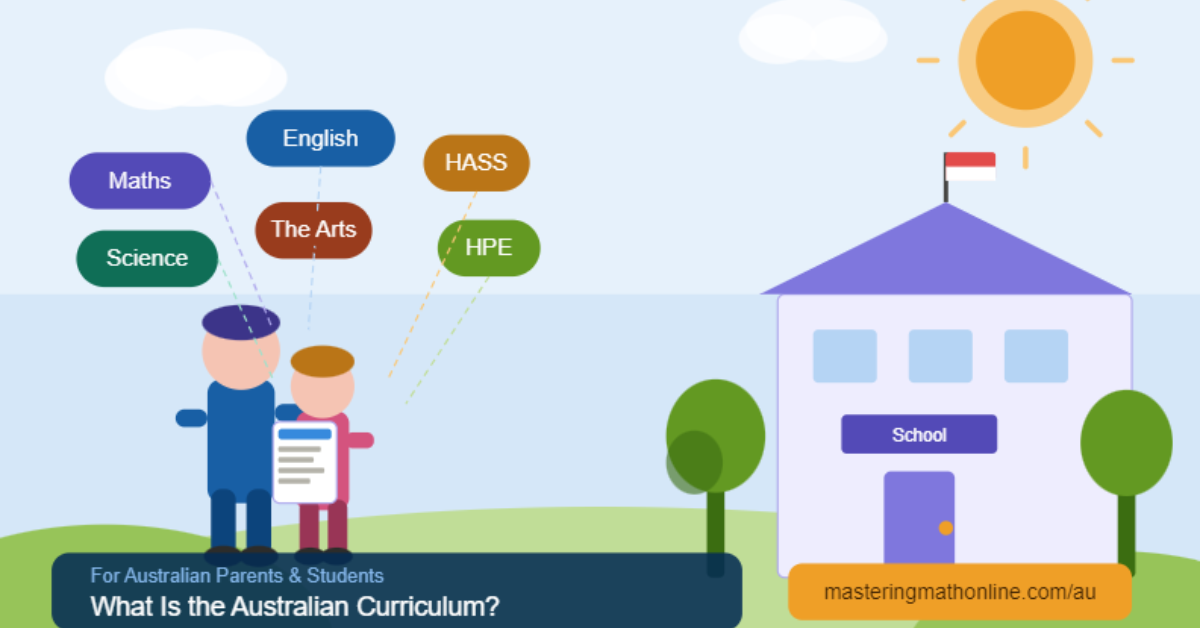
Learning Areas are the core subject areas — the “what” of what your child learns. There are eight official Learning Areas in the Australian Curriculum:
| Learning Area | What It Covers |
|---|---|
| English | Reading, writing, speaking, listening, and literature |
| Mathematics | Number, algebra, measurement, statistics, probability |
| Science | Biological, chemical, earth, and physical sciences |
| Humanities & Social Sciences (HASS) | History, geography, civics, economics |
| The Arts | Drama, dance, music, media arts, visual arts |
| Technologies | Design, digital technologies, food and fibre production |
| Health & Physical Education (HPE) | Physical literacy, personal health, wellbeing |
| Languages | Learning an additional language (e.g., Mandarin, Indonesian, French) |
What Does This Look Like in Practice?
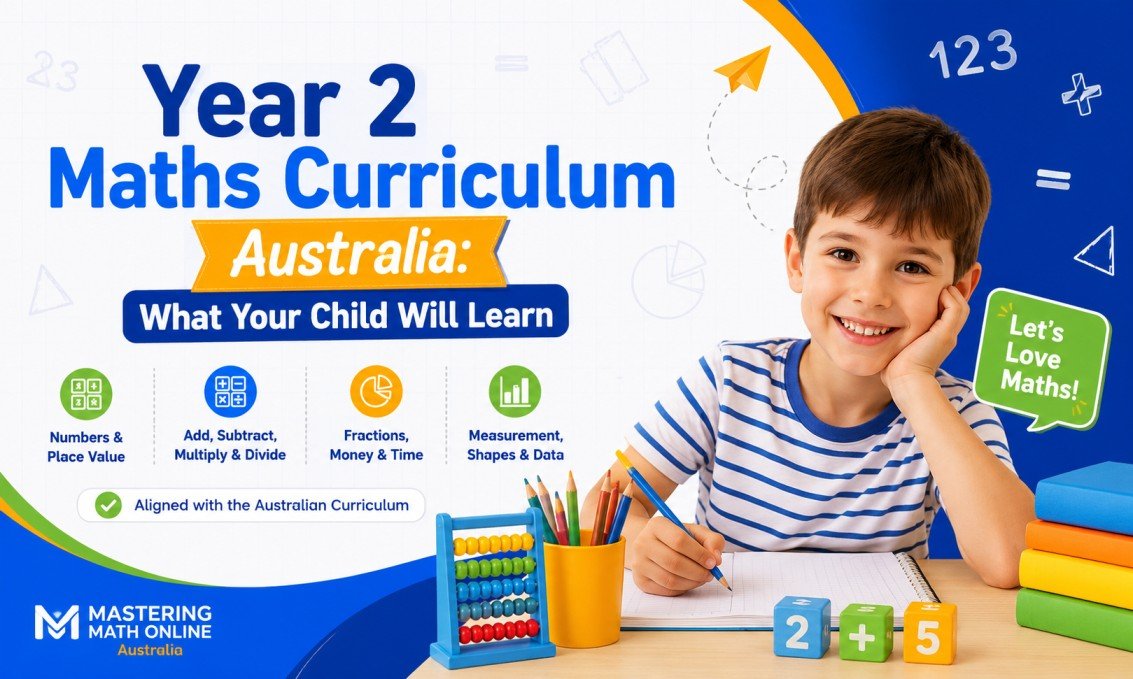
In Mathematics, the curriculum covers strands like Number, Algebra, Measurement, Space, Statistics, and Probability — carefully scaffolded across year levels. By Year 5, students are expected to understand fractions, decimals, and basic geometric concepts. By Year 9 maths, they’re tackling linear equations and data analysis.
This is exactly why many Australian families turn to Mastering Math Online, a dedicated online maths tutoring platform built around the Australian Curriculum. When children fall behind in a specific strand, targeted practice aligned to their year-level curriculum can make a real difference.
Dimension 2: General Capabilities
General Capabilities are arguably the most misunderstood part of the curriculum. They aren’t a separate subject — they’re the transferable skills and dispositions that students develop through their learning across all areas.
Think of them as the qualities that prepare your child not just for exams, but for life and the modern workforce.
There are seven General Capabilities:
1. Literacy
Not just reading and writing in English class — literacy skills are applied across every subject. A Science student writing a lab report is practising literacy. A Maths student reading a worded problem is too.
2. Numeracy
Similarly, numeracy isn’t exclusive to Maths. Understanding data in Science, calculating costs in HASS, reading graphs in HPE — numeracy is everywhere.
3. Digital Literacy
Students learn to use technology confidently and responsibly — from coding basics to evaluating online information critically.
4. Critical and Creative Thinking
This includes questioning, problem-solving, generating new ideas, and reflecting on learning. It’s increasingly valued in STEM fields.
5. Personal and Social Capability
Students develop self-awareness, empathy, teamwork, and communication skills. These are sometimes called “soft skills” — but in today’s world, they’re anything but soft.
6. Ethical Understanding
Students learn to explore values, rights, and responsibilities — examining ethical questions across subjects and real-world contexts.
7. Intercultural Understanding
Australia is one of the most multicultural nations on earth. This capability helps students appreciate diverse perspectives and engage respectfully with different cultures.
Parent Tip: When your child is working on a school project, try asking: “What skills are you using to put this together?” You’ll often be surprised at how many General Capabilities they’re applying without even realising it!
Dimension 3: Cross-Curriculum Priorities
Cross-Curriculum Priorities are the big-picture themes that all learning areas are expected to address. There are three priorities:
1. Aboriginal and Torres Strait Islander Histories and Cultures
This priority ensures all Australian students develop a deep understanding and respect for the world’s oldest living cultures. It’s not just about history — it’s woven into Science (Indigenous land management), Maths (cultural patterns and measurement), and The Arts (storytelling traditions).
2. Asia and Australia’s Engagement with Asia
Australia exists in the Asia-Pacific region, and this priority acknowledges that. Students learn about Asian cultures, languages, economies, and histories — building skills relevant to Australia’s future.
3. Sustainability
From climate science to ethical consumption, this priority encourages students to think about the long-term wellbeing of the planet. It appears in HASS, Science, Technologies, and even Maths through data and statistics on environmental topics.
These priorities aren’t a separate “subject” — they’re threads that teachers intentionally weave through day-to-day lessons.
How the Australian Curriculum Actually Works in Schools
Understanding the structure is one thing. Seeing how it translates into your child’s school day is another.
From Curriculum to Classroom
ACARA sets the national curriculum framework, but individual states and territories then adapt it slightly for local implementation. Here’s how it works: ACARA creates the blueprint, and each state or territory education authority builds their own syllabus or curriculum document on top of it — keeping the core learning outcomes but adjusting the language, sequencing, and local context.
This means your child’s school might use slightly different terminology or emphasis — but the foundational learning expectations remain consistent nationally.
Year Levels and Achievement Standards
Each subject within the curriculum includes:
- Content descriptions — what students are taught at each year level
- Achievement standards — what students should be able to demonstrate by the end of that year
- Work samples — examples of student work at different levels of achievement
This helps teachers design lessons, assess students fairly, and communicate progress to parents clearly.
How Is Progress Reported?
Schools typically assess students against five levels of achievement:
- Excellent
- High
- Sound
- Limited
- Very Limited (or similar terminology depending on the state)
These levels correspond to how well a student has met the achievement standards for their year level.
What Every Parent Needs to Know
This is one of the most practically important — and most overlooked — aspects of the Australian Curriculum. While ACARA provides the national framework, how the curriculum is delivered varies significantly depending on your state, your child’s school type, and even the year level they’re in. Here’s what that really means for your family.
How Each State and Territory Adapts the Curriculum
Think of the Australian Curriculum as the national recipe, and each state or territory as a chef who adds their own local flavour. The core ingredients are the same, but the presentation differs.
| State / Territory | Curriculum Authority | Local Curriculum Name | Key Notes |
|---|---|---|---|
| New South Wales | NESA | NSW Syllabus | Most distinct adaptation; NESA rewrites content descriptions in its own format. Strong emphasis on explicit assessment standards. |
| Victoria | VCAA | Victorian Curriculum F–10 | Closely mirrors the national curriculum; includes additional local context around Victorian history and communities. |
| Queensland | QCAA | Queensland Curriculum (aligned to AC) | Uses the Australian Curriculum directly with Queensland-specific support materials. Strong focus on senior schooling pathways from Year 10. |
| Western Australia | School Curriculum & Standards Authority (SCSA) | WA Curriculum | Aligned to AC Version 8.4 (transitioning to V9.0); WA has historically been slower to adopt national updates. |
| South Australia | DECD / SACE Board | AC aligned | Uses the Australian Curriculum directly for F–10; has its own SACE framework for Years 11–12. |
| Tasmania | TasTAFE / DoE Tasmania | AC aligned | Directly adopts the national curriculum with Tasmanian contextualisation in HASS and sustainability. |
| ACT | ACT Education | AC aligned | Closely follows the national curriculum; known for progressive implementation of new versions. |
| Northern Territory | NT Department of Education | AC aligned | Directly uses the Australian Curriculum; additional focus on Indigenous education given NT’s demographics. |
Parent Takeaway: If your child moves interstate, their new school will cover the same broad learning outcomes — but the assessment tasks, reporting language, and subject sequencing may feel different. It’s always worth requesting a learning progress report when transferring schools.
Government, Catholic, and Independent
The type of school your child attends also influences how the Australian Curriculum is delivered.
Government (Public) Schools
Government schools are directly governed by their state education department and are required to implement the local state-based curriculum in full. There’s less flexibility in what is taught, though teachers still have creative freedom in how they teach it.
Catholic Schools
Catholic schools operate under their own diocesan authorities (e.g., Catholic Education Melbourne, Catholic Schools NSW). They follow the Australian Curriculum but may integrate faith-based perspectives into subjects like HASS, English (through literature choices), and Ethics. They often have more flexibility in resource selection and program design.
Independent and Private Schools
Independent schools have the greatest degree of curriculum flexibility. While they must meet the same broad Australian Curriculum standards, they may:
- Deliver content in a different sequence
- Offer alternative learning programs (e.g., Montessori, International Baccalaureate, Steiner)
- Allocate significantly more time to particular Learning Areas (e.g., STEM-focused schools, or schools with an arts specialisation)
- Accelerate high-achieving students through curriculum content ahead of their year level
Important Note: Even schools offering the International Baccalaureate (IB) program are still expected to meet Australian Curriculum standards for reporting purposes — but the pedagogical approach and assessment style are quite different from a standard state-school experience.
Across Year Levels: Foundation to Year 10
The curriculum doesn’t feel the same at every stage of schooling — and that’s by design. Here’s how the focus shifts as your child progresses:
Foundation to Year 2 (Early Childhood)
The emphasis here is on play-based and inquiry learning. Literacy and numeracy are the clear priorities, but the curriculum is intentionally flexible. Schools have significant latitude in how they structure the school day and integrate learning areas. You’ll often see subjects blended together rather than taught in isolation.
Years 3 to 6 (Primary — Middle Years)
This is where subjects become more clearly defined and structured. NAPLAN assessments (Years 3 and 5) provide a national benchmark, and the curriculum becomes more demanding. Maths strands like fractions, decimals, and multiplication tables become central — this is often where learning gaps first become visible.
Years 7 to 8 (Lower Secondary — Transition Years)
The jump from primary to secondary is one of the most significant transitions in a student’s schooling journey. Subject areas become more specialised, taught by different teachers in different classrooms. The curriculum demands greater independence and abstract thinking — particularly in Mathematics, where algebra, geometry, and statistics all intensify simultaneously.
Years 9 to 10 (Upper Secondary — Consolidation)
By Years 9 and 10, students are effectively preparing for their senior school pathways. The Australian Curriculum becomes a foundation for state-specific senior curricula (like the HSC in NSW, VCE in Victoria, or QCE in Queensland). Students begin to see how their Learning Areas connect to future career pathways, and subject selection decisions (especially in Year 10) carry real consequences for senior school options.
For Maths specifically: A student who hasn’t consolidated their Year 10 Maths outcomes may find themselves locked out of advanced maths subjects in Years 11 and 12 — which in turn affects university entrance options.
How Teachers Interpret the Curriculum
Even within the same school, two teachers at the same year level may deliver the curriculum quite differently — and that’s perfectly normal. The Australian Curriculum gives teachers professional autonomy in:
- Choosing how to sequence content within a term or year
- Selecting resources and texts (especially in English and HASS)
- Designing assessment tasks that suit their class’s needs
- Integrating General Capabilities in ways that suit the learning context
- Differentiating instruction for students who are ahead of or behind year-level expectations
This is why two Year 6 students at different schools — or even in different classrooms at the same school — might have very different school experiences, even though they’re technically studying the same curriculum.
What Curriculum Means for You as a Parent
Understanding variation helps you:
- Ask better questions at parent-teacher nights: “How does this assessment align with the Year X achievement standards?” is a much more useful question than “Why did my child get a B?”
- Make sense of interstate moves: If you relocate, your child isn’t starting over — they’re continuing the same national framework in a slightly different dialect.
- Identify real gaps vs. teaching style differences: Not every difference in performance is a learning gap. Sometimes it’s a mismatch in teaching approach — and sometimes targeted support is needed. Either way, knowing the curriculum helps you have that conversation confidently.
- Support at-home learning effectively: When you know what year-level content looks like (e.g., Year 7 Maths covers linear equations and proportion), you can find resources like Mastering Math Online that are genuinely aligned to where your child is in their learning journey, not generic study guides that may or may not match what their teacher is covering.
5 Things Every Parent Should Know About the Australian Curriculum
- It’s a guide, not a script. The curriculum sets what students should learn, but teachers have flexibility in how they teach it. Two Year 5 classrooms might cover the same content very differently.
- General Capabilities aren’t graded separately. They’re embedded in subject assessments — so a low Maths score might partly reflect a literacy challenge in reading worded problems.
- Not all schools teach all Learning Areas equally. Schools must cover the core subjects but may offer limited Languages or Arts programs depending on their size and resources.
- The curriculum is regularly updated. Version 9.0 (2022) was a significant revision. Always check ACARA’s website for the most current version.
- Your state’s curriculum might differ slightly. Always check your state education authority’s website for local implementation details.
Conclusion: Knowledge Is Your Greatest Parenting Tool
The Australian Curriculum isn’t just a document for teachers and policymakers — it’s a roadmap for your child’s education. When you understand the three dimensions (Learning Areas, General Capabilities, and Cross-Curriculum Priorities), you’re better equipped to:
- Have meaningful conversations with your child’s teachers
- Recognise where your child is thriving — and where they need support
- Make informed choices about extra support or enrichment
Ready to give your child the maths edge they deserve? Visit masteringmathonline.com/au today and explore how expert online tutoring can complement everything the Australian Curriculum has to offer.
Frequently Asked Questions (FAQs)
Q1: What is the Australian Curriculum in simple terms?
It’s the national framework that defines what Australian students in Foundation to Year 10 learn across eight core subject areas, along with skills and broader themes embedded in all subjects.
Q2: Is the Australian Curriculum the same in every state?
No. Each state and territory has its own curriculum authority that adapts the national framework. NSW uses NESA syllabuses, Victoria uses the Victorian Curriculum, and other states have their own versions. The core learning outcomes are consistent, but terminology, sequencing, and assessment can differ noticeably.
Q3: What are General Capabilities in the Australian Curriculum?
They are seven cross-subject skills — including Literacy, Numeracy, Digital Literacy, and Critical Thinking — developed through all Learning Areas rather than taught as separate subjects.
Q4: When was the Australian Curriculum last updated?
The most recent major revision was Version 9.0, introduced in 2022, with strengthened focus on STEM, literacy, and numeracy.
Q5: How can I support my child at home with the Australian Curriculum?
Stay informed about what year-level content your child is covering, communicate regularly with their teacher, and consider targeted support tools like Mastering Math Online for curriculum-aligned maths practice.