
Learning maths tables is one of the most important milestones in a child’s education. When kids know their times tables confidently, they solve problems faster, feel less anxious in class, and build a strong foundation for every maths topic ahead, from fractions and algebra through to senior school calculus. This guide gives Australian parents practical, proven strategies to help children at any year level master multiplication facts without tears or tedium.
Why Maths Tables Matter for Australian Students
The Australian Curriculum v9.0 (ACARA) expects students to develop fluency with multiplication facts from Year 2 onwards. By Year 4, children are expected to recall facts up to 10 × 10 with confidence. That fluency directly supports success in primary school maths and sets kids up well before they reach secondary school.
When a child struggles to recall basic facts, they spend mental energy on simple calculations instead of focusing on the bigger problem — leading to slower work, careless errors, and growing frustration.
Strong table knowledge pays off in:
- Mental arithmetic and estimation
- NAPLAN numeracy assessments
- Fractions, ratios, and percentages
- Algebra in Year 7 and beyond
- Everyday life situations — shopping, cooking, sport statistics
At What Age Should Children Learn Times Tables?
In Australia, most schools introduce multiplication concepts around Year 2 (ages 7–8), with formal table learning from Year 3. By Year 4, the expectation is solid recall of facts up to 10 × 10, and many schools extend this to 12 × 12.
However, every child develops at their own pace. If your child is in Year 5 or Year 6 and still shaky on their tables, that is absolutely fixable — the right approach makes all the difference.
Where to Start: The Easiest Tables First
Not all multiplication facts are equal in difficulty. Research and classroom experience consistently show that children learn fastest when they begin with the simplest patterns.
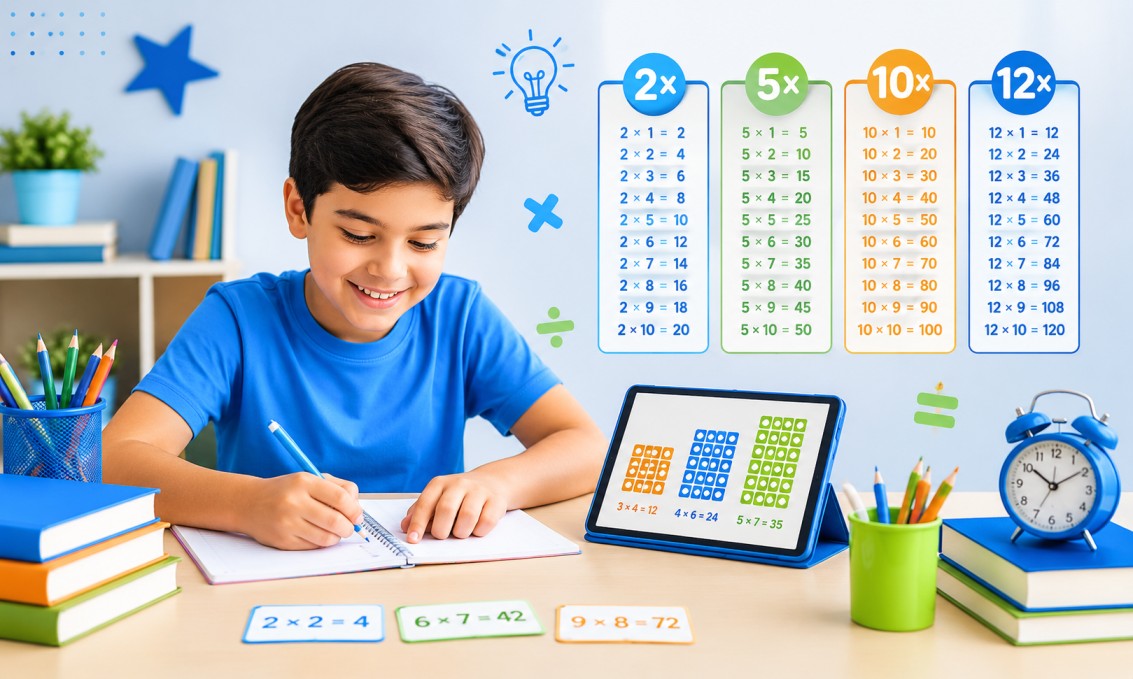
Start With 2s, 5s, and 10s
These three tables follow clear, predictable patterns that young learners grasp quickly:
- 2 times table — doubling; children often already know this from addition
- 5 times table — ends in 0 or 5 every time; easy to count along
- 10 times table — always ends in 0; the easiest pattern in multiplication
Mastering these early gives children early wins, which builds confidence and motivation to continue.
Move to 3s, 4s, and 6s
Once the foundational three are secure, introduce these. The 4s are simply the 2s doubled, so children who already know their 2s have a helpful shortcut.
Tackle 7s, 8s, and 9s Last
These are widely regarded as the trickiest tables. The good news is that by the time a child reaches these, they already know most of the answers from earlier tables — because multiplication works both ways (commutative property). For example, 7 × 8 = 8 × 7 = 56.
The 9s also have a popular finger trick (explained below) that makes them much more approachable.
10 Proven Ways to Teach Maths Tables at Home
1. Use a Times Table Chart on the Wall
Print a completed multiplication grid and hang it somewhere your child sees every day — above their desk, on the fridge, or in the bathroom. Passive exposure reinforces facts over time, even without active study.
2. Teach the Commutative Property Early
Show your child that 4 × 6 and 6 × 4 give the same answer. This single insight cuts the number of facts a child needs to memorise by almost half. Instead of 144 individual facts (a 12 × 12 grid), they only need to learn about 66 unique combinations.
3. Skip Counting
Skip counting is a natural bridge between addition and multiplication. Practice counting in 3s, 4s, 6s, and 7s aloud while walking, driving, or during bath time. When children can skip count fluently, recalling table facts becomes much faster.
4. Use the 9s Finger Trick
Hold both hands out flat. To calculate 9 × 4, fold down the fourth finger from the left. The fingers to the left of the folded finger = tens digit (3). The fingers to the right = units digit (6). Answer: 36. This trick works for 9 × 1 through 9 × 10 and children absolutely love it.
5. Times Table Songs and Rhymes
Music is a powerful memory tool. Catchy songs make facts stick without feeling like study. Search for multiplication songs on YouTube. There are many free, high-quality options set to popular tunes that children already enjoy. Even 10 minutes of singing at home each week makes a measurable difference.
6. Card Games and Board Games
Turn practice into play. A simple card game using a standard deck works well: each player flips a card, and the first person to correctly state the product of both cards wins the pair. The child with the most cards at the end wins. No worksheets required.
7. Timed Recall Challenges
Short, sharp quizzes build speed and automaticity. Start with just 10 facts and time your child with a stopwatch. Record their time each day. Seeing their own improvement is a powerful motivator. Keep sessions to five minutes — short and frequent beats long and infrequent every time.
8. Worksheets With Variety
Structured written practice helps facts move into long-term memory. A mix of questions — fill-in-the-blank, mixed order, word problems — keeps practice from feeling repetitive. Avoid drilling only in order (1×, 2×, 3×…) as this creates sequence-dependent recall that falls apart in real tests.
9. Connect Tables to Real Life
Bring multiplication into daily situations naturally. How many wheels on 6 bikes? (6 × 2). How much do 4 chocolate bars cost at $3 each? (4 × 3). Real-life context shows children why tables matter, not just what the answers are.
10. Consistent Short Practice Sessions
Little and often beats cramming every single time. Even 5–10 minutes daily — during breakfast, in the car on the school run, or before bed — produces far better results than an hour-long session once a week. Consistency is the key variable.
Common Mistakes Parents Make (and How to Avoid Them)
Drilling only in sequence. Reciting the 7 times table from 7 × 1 to 7 × 12 in order is not the same as knowing it. Children need to recall facts in random order to build genuine fluency.
Expecting overnight results. Memorising multiplication facts takes weeks of consistent practice, not days. Stay patient and focus on gradual progress rather than perfection.
Saying “I was never good at maths.” This phrase, even when said lightheartedly, can cause children to believe maths ability is fixed and inherited. Instead, tell them that anyone can improve with the right practice and support.
Skipping foundations. If a child doesn’t yet understand what multiplication means — that it is repeated addition, groups of equal size — pure memorisation is built on sand. Always confirm conceptual understanding before drilling for speed.
How Online Tutoring Supports Times Table Learning
Sometimes home practice isn’t enough, and that’s completely normal. A qualified tutor can identify exactly which facts are shaky, apply targeted strategies, and rebuild a child’s confidence quickly — often in just a few sessions.
At Mastering Math Online, our specialist tutors work one-on-one with students from Year 1 through to Year 6 on foundational skills including times tables, number sense, and mental arithmetic. Every lesson follows the Australian Curriculum, and parents receive a written progress report after each session.
If your child is approaching NAPLAN, strong table recall is directly tested in the numeracy component — making it one of the highest-leverage skills to sharpen before assessment day.
Times Tables and the Australian Curriculum v9.0
Under the updated ACARA framework, multiplication sits within the Number strand and connects to Algebra through pattern recognition and generalisation. Tutors at Mastering Math Online are trained in v9.0, so every lesson reflects exactly what your child’s classroom teacher is covering — not an outdated or overseas syllabus.
Year-by-year expectations:
| Year Level | Multiplication Expectation |
|---|---|
| Year 2 | Recognise and represent multiplication as groups |
| Year 3 | Recall facts for 2, 3, 5, and 10; use arrays |
| Year 4 | Recall facts up to 10 × 10; apply in problem solving |
| Year 5 | Use multiplication to solve multi-digit and fraction problems |
| Year 6 | Apply fluently across all number operations |
Frequently Asked Questions
Q: What is the best age to start learning times tables in Australia? Most Australian children begin formal times table learning in Year 3 (around age 8–9), following the ACARA curriculum. However, informal skip counting and grouping concepts start as early as Year 2.
Q: How long does it take to learn all the times tables? With consistent daily practice of 5–10 minutes, most children can achieve solid recall of tables up to 12 × 12 within 8–12 weeks. Individual pace varies, and that is perfectly normal.
Q: Which times table should a child learn first? Start with the 2s, 5s, and 10s — these follow the most obvious patterns and give children early confidence before moving to trickier facts like 7s, 8s, and 9s.
Q: Do Australian schools still teach times tables? Yes. The Australian Curriculum v9.0 explicitly requires fluency in multiplication facts. Most primary schools begin formal table practice in Year 3, with mastery expected by the end of Year 4.
Q: Can an online maths tutor help my child with times tables? Absolutely. One-on-one tutoring is highly effective for targeted gaps like specific table facts. At Mastering Math Online, tutors identify exactly which facts are missing and use proven strategies to fill those gaps quickly — often within just a few sessions.