
Both online and face-to-face tutoring can genuinely improve a student’s maths results, and the research backs this up. Evidence for Learning found that one-to-one tuition adds an average of five months of extra academic progress in Australian classrooms, regardless of whether the lessons happen on a screen or across a kitchen table. So the honest answer to which format is better is that it depends far less on the delivery method and far more on the tutor’s quality, the regularity of sessions, and how well the format fits your child.
For most Australian families juggling school, sport, and long commutes, online tutoring now matches or beats in-person results when it is delivered with the right tools, structured lesson plans, and a qualified tutor. This guide breaks down exactly when each format works best, what the research shows, and how to choose with confidence.
What the Research Actually Shows
Parents often assume face-to-face lessons must be more effective simply because they feel more traditional. The evidence tells a more balanced story.
Multiple international trials and Australian studies have found that online tutoring produces learning gains comparable to face-to-face tuition, and in some cases slightly better, particularly for students who were struggling before they started. The key ingredients are consistency, clear goals aligned to the curriculum, and fast, specific feedback, not the format itself.
Primary-aged students tend to gain the most from one-to-one tutoring overall, with Australian data showing around six months of extra progress at primary level compared to roughly four months at secondary level. This matters more when choosing how often to tutor than whether to tutor online or in person.
Online Tutoring: Where It Excels
The Strengths
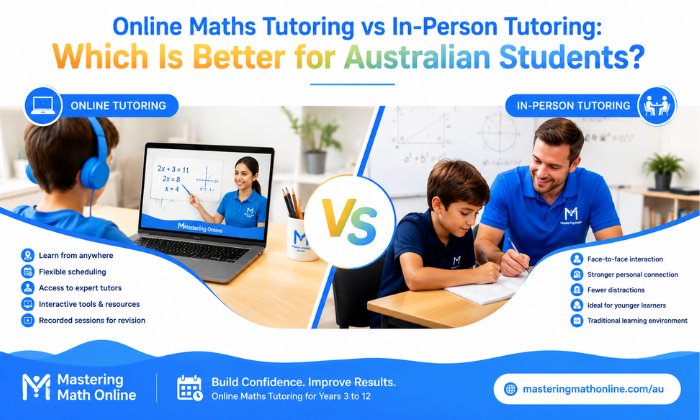
- Access to a much larger pool of qualified tutors, not just whoever is available locally
- Interactive whiteboards let the student and tutor write, graph, and annotate maths problems together in real time
- Sessions can be recorded, so students can revisit a tricky method before homework or a test
- No travel time, which suits families in regional areas or with tight after-school schedules
- Easy to book sessions around exam blocks, holidays, or sudden gaps in understanding
The Limitations
- Relies on a stable internet connection and a reasonably quiet space at home
- Younger students sometimes need a parent nearby to help them stay focused in the first few sessions
- A tutor cannot physically pick up a pen and correct working on paper, though a shared digital whiteboard largely solves this
Face to Face Tutoring: Where It Excels
The Strengths
- Body language and hesitation are easier for some tutors to read in person
- Works well for students who find screens distracting or who need a change of physical environment to focus
- No dependence on technology, so there is nothing to trouble shoot mid lesson
The Limitations
- Limited to tutors who live within a reasonable travel distance
- Travel time cuts into the family’s evening or weekend, and can make weekly consistency harder to maintain
- Fewer options for last minute or holiday sessions before exams
- Often costs more once travel time is factored into the tutor’s rate
Which Format Suits Which Student?
The right choice usually comes down to the student’s age, personality, and what they are studying for.
- Years 1 to 6 (foundations and NAPLAN prep): Online works well when a parent is nearby for the first few sessions, since young learners respond strongly to structured, game based digital tools
- Years 7 to 10 (core skills and Selective School prep): Most students this age are comfortable online, and the wider tutor pool makes it easier to match subject specific expertise, such as Selective School exam technique
- Years 11 and 12 (HSC, VCE, QCE, WACE, SACE, ATAR): Exam stakes are high, so access to a tutor who deeply understands your state’s syllabus and marking criteria matters more than physical location, which is where online tutoring has a clear edge
- Students who lose focus easily on screens may do better with a hybrid approach, mixing occasional in-person sessions with regular online lessons
Cost Comparison
Online tutoring cost is often, though not always, less expensive than in-person lessons. This is because tutors do not need to charge for travel time or fuel, and they are not limited to clients in one suburb, which keeps rates competitive.
That said, price should never be the only factor. A cheaper tutor who is a poor match for your child’s syllabus, or who cancels sessions frequently, will cost more in lost progress than a well matched tutor at a slightly higher rate.
How to Choose the Right Format for Your Family
A few practical questions can make the decision straightforward.
- Does your child already spend a lot of time on screens for school, and would another screen based activity help or hinder focus?
- How much travel time would face to face lessons realistically add to your week?
- Is your child preparing for a specific exam, such as NAPLAN, Selective School, HSC, VCE, or QCE, where syllabus specific expertise matters more than proximity?
- Would your child benefit from being able to rewatch a lesson recording before a test?
- Is consistency likely to be easier to maintain online, given your family’s schedule?
Conclusion
There is no universal winner between online and face to face tutoring. The research is clear that both formats can deliver strong results when the tutor is qualified, sessions are regular, and the lessons are aligned to what the student is actually studying at school.
For most Australian families, particularly those preparing for NAPLAN, Selective School, HSC, VCE, QCE, WACE, or SACE, online tutoring offers the strongest combination of expert access, flexibility, and value. At Mastering Maths Online, every lesson is one-on-one, aligned to the Australian Curriculum v9.0, and delivered by tutors who know your state’s exams inside out, so your child gets the benefits of face to face style teaching without the commute.
Frequently Asked Questions
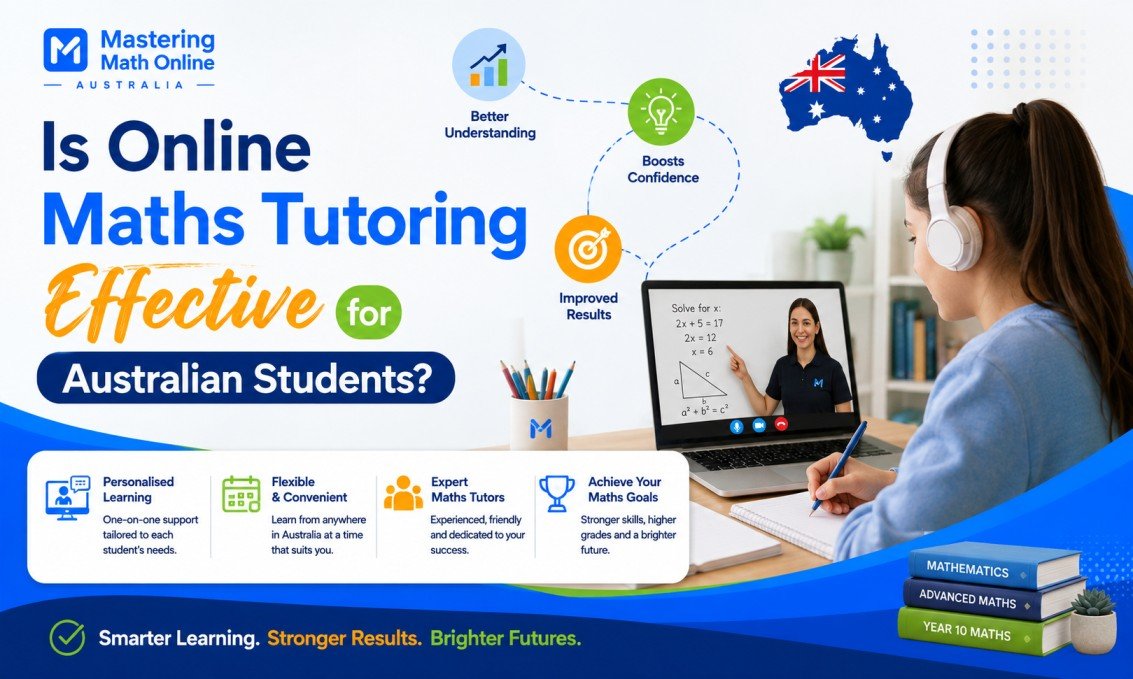
Yes, online tutoring is highly effective as it offers personalised learning, flexible scheduling, and access to expert tutors across Australia.
Online tutoring is generally more affordable because it eliminates travel costs and reduces overall expenses.
Yes, but younger students may need parental support to stay focused during sessions.
Yes, one-on-one online sessions often provide equal or even better individual attention compared to in-person tutoring.
Consider your child’s learning style, age, schedule, and comfort level with technology before deciding.