
Online maths tutoring connects students with qualified maths tutors through a live virtual classroom, accessible from home on any device. There is no commute, no classroom of 30 students, and no one-size-fits-all lesson plan. Instead, each session is focused entirely on one student, their specific gaps, their current curriculum, and the pace that works best for them. For Australian families navigating everything from primary school number skills to Year 12 specialist content, online tutoring has become a practical and effective way to get the right support at the right time. This guide explains exactly how it works, what to expect, and how to make the most of it.
The Basics: What Actually Happens in an Online Tutoring Session?
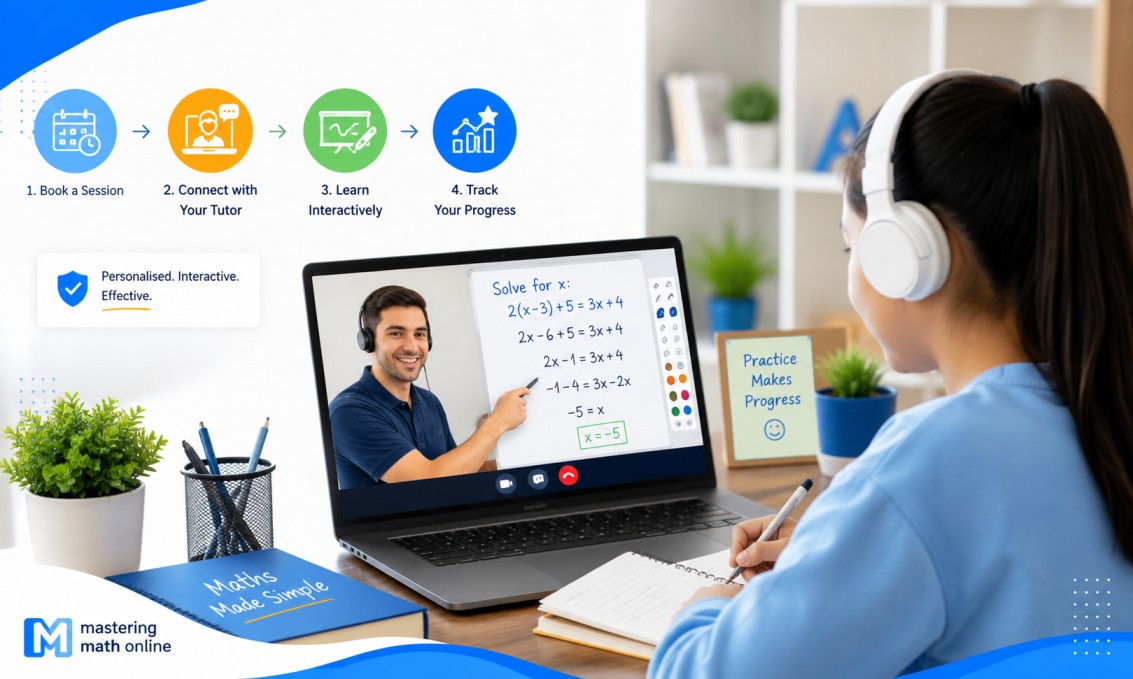
A typical online maths tutoring session runs between 45 and 60 minutes. The student and tutor connect through a secure video platform, and the tutor uses a combination of screen sharing, a digital whiteboard, and typed or spoken explanations to work through problems in real time.
It looks a lot like sitting next to a tutor at a kitchen table, except everything happens on screen. The tutor can write out working, draw diagrams, highlight key steps, and adjust their explanation on the spot based on how the student responds.
Most sessions follow a simple rhythm. The tutor checks in on what the student has been working on, reviews any homework or test results, teaches new concepts or revisits confusing ones, and then works through practice questions together before setting tasks for the student to try independently before the next session.
Step by Step: How Online Maths Tutoring Works
| Step | Stage | What Happens |
| 1 | Book a Session | Choose your tutor, pick a time that suits, and confirm your booking online in minutes. |
| 2 | Join the Virtual Classroom | Log in from any device. No software installation needed. Just a stable internet connection. |
| 3 | Work Through Problems Together | Your tutor shares their screen, uses a digital whiteboard, and explains concepts in real time. |
| 4 | Get Personalised Feedback | Your tutor identifies gaps in understanding and adjusts the lesson to suit your needs. |
| 5 | Review and Practise | Session notes or recordings help you revise what was covered between lessons. |
The process is designed to be straightforward. Most platforms used by quality tutoring services require nothing more than a web browser and a stable internet connection. Students do not need to install anything or own any special equipment.
What Tools Are Used in Online Maths Tutoring?
The tools vary slightly between tutoring services, but the core setup is consistent across most quality providers. Here is what a student can typically expect.
- Digital whiteboard: The tutor writes out working, draws graphs, and annotates diagrams in real time. The student can see every step as it happens.
- Video and audio: Live face-to-face communication makes it easy for the student to ask questions and for the tutor to pick up on confusion quickly.
- Screen sharing: Tutors can share textbook pages, past exam papers, or practice worksheets directly on screen.
- Chat function: Useful for sharing links, typing out equations, or clarifying something quickly without interrupting the flow of the lesson.
- Session recordings or notes: Many services offer the option to record lessons or provide written summaries, giving students something to refer back to when revising.
| Tip for parents: Ask your tutoring provider whether sessions are recorded. A recorded lesson is one of the most underused revision tools available to students. Being able to rewatch a tutor’s explanation of a tricky concept is genuinely valuable, especially in the lead-up to exams. |
How Is the Tutoring Personalised to Each Student?
This is one of the biggest advantages of one-on-one online tutoring over group classes or tutoring centres. There is no shared curriculum to stick to and no other students to keep pace with.
Initial Assessment
Most services start with an initial session or assessment to identify where the student is right now. This helps the tutor understand which topics are solid, which are shaky, and where the biggest gaps are. For a Year 8 student struggling with algebra, for instance, the tutor might find that the root issue goes back to gaps in fractions or order of operations from Year 6.
Curriculum Alignment
A good online maths tutor will work directly from the student’s current school curriculum. In Australia, this means aligning lessons with the Australian Curriculum and the specific state-based requirements for each year level. Whether a student is preparing for NAPLAN, working through a VCE Methods topic, or just trying to keep up with Year 4 multiplication, the content should match what they are being taught at school.
Adjusting Pace and Approach
Online tutoring allows the tutor to slow down when something is not clicking and move faster when the student is ready. This is something a classroom teacher simply cannot do for 25 students at once. The one-on-one format means the lesson genuinely adapts to the student, not the other way around.
Who Is Online Maths Tutoring Best Suited To?
Online tutoring works well for a wide range of students. It is particularly effective for:
- Students who are falling behind and need to catch up on missed or misunderstood content
- Students who are keeping up but want to build more confidence and accuracy
- High-achieving students who want to be challenged beyond what the classroom offers
- Students in regional or rural areas who do not have easy access to local tutors
- Busy families who need flexibility around sport, activities, and school commitments
- Students preparing for NAPLAN, HSC, VCE, QCE, or other major assessments
| Real example: A Year 10 student in regional Queensland who was struggling with quadratic equations started online tutoring twice a week. Within six weeks, her teacher noticed a marked improvement in her test results and her classroom participation. The flexibility of online sessions meant she could fit tutoring around her after-school commitments without any added stress. |
How to Get Started with Online Maths Tutoring
Getting started is simpler than most parents expect. Here is what the process generally looks like.
- Step 1: Contact the tutoring service and share some basic information about your child, their year level, the state curriculum they follow, and what they are finding difficult.
- Step 2: The service matches your child with a tutor who has experience with that year level and curriculum.
- Step 3: You book a first session at a time that suits your family. Many services offer evening and weekend availability.
- Step 4: Your child logs in from their laptop, tablet, or desktop computer and the session begins.
- Step 5: After the first session, you can discuss how it went with the tutor and adjust the focus or frequency as needed.
Conclusion
Online maths tutoring is a straightforward, flexible, and highly effective way to support your child in maths, regardless of their year level or the state they are studying in. The one-on-one format, the personalised curriculum alignment, and the convenience of learning from home make it a practical option for Australian families.
The technology is simple to use, the sessions are structured around what the student actually needs, and the results are measurable. If your child is struggling, falling behind, or simply wants to perform better, online maths tutoring is one of the most direct ways to make that happen.
Mastering Maths Online provides expert one-on-one tutoring for students from Year 1 through to Year 12, across all Australian states and territories.
Frequently Asked Questions
No. Most online tutoring platforms run entirely through a web browser. All you need is a device with a camera, a microphone, and a reliable internet connection.
Most sessions run for 45 to 60 minutes. The length can usually be adjusted to suit the student’s age, concentration level, and the amount of content to cover.
A good tutor will give you regular feedback after sessions. Progress also shows up in school test results, homework confidence, and the student’s willingness to engage with maths independently.
Yes. Exam preparation is one of the most common reasons families seek tutoring. A tutor can work through past papers, target weak areas, and help students develop exam technique and time management skills.
Once a week is a good starting point for most students. Students who are significantly behind or facing upcoming exams often benefit from two sessions per week until they catch up or reach their target.