
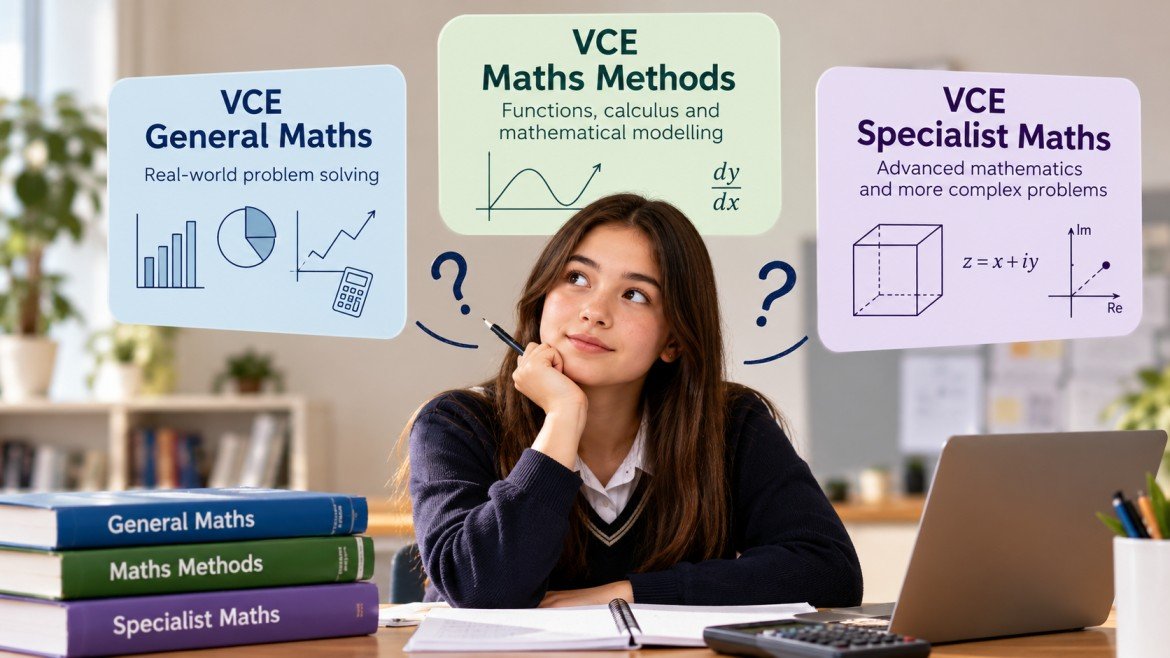
Choosing your VCE maths subjects can feel like a big decision. Should you take General Maths because it seems more manageable? Is Mathematical Methods worth the extra challenge? And do you really need Specialist Mathematics to study engineering or science at university?
The answer depends on more than your Year 10 maths marks. Your interests, algebra skills, future study plans and willingness to tackle challenging problems all matter.
This guide compares VCE General Maths vs Maths Methods vs Specialist Maths, explains what you will actually study, and helps you make a confident, informed choice for Years 11 and year 12.
Which VCE Maths Subject Should You Choose? The Short Answer
Choose General Mathematics if you prefer applied mathematics involving statistics, finance, matrices and networks, and your intended university courses do not require Mathematical Methods.
Choose Mathematical Methods if you enjoy algebra, functions, calculus and probability, or want to keep open university pathways that specifically require Methods.
Choose Specialist Mathematics alongside Methods if you have strong mathematical foundations, enjoy advanced problem-solving and want to explore more demanding topics such as vectors, complex numbers and differential equations.
Specialist Mathematics is generally the most challenging of these subjects, followed by Mathematical Methods and General Mathematics. However, difficulty alone should not determine your choice.
Before finalising your subjects, check the prerequisites for university courses you might consider and discuss your options with your school.
VCE General Maths vs Methods vs Specialist Maths Comparison
| Feature | General Mathematics | Mathematical Methods | Specialist Mathematics |
|---|---|---|---|
| Main focus | Applied mathematics and modelling | Algebra, functions, calculus and probability | Advanced mathematical reasoning and applications |
| Relative difficulty | Generally more accessible | More demanding algebraically | Most demanding |
| Major topics | Data analysis, financial maths, matrices, networks | Functions, differentiation, integration, probability | Vectors, complex numbers, proof, differential equations |
| Calculus | Not a central component | Major component | Extends calculus further |
| Best suited to | Students interested in applied maths | Students comfortable with algebra and abstract concepts | Strong maths students who enjoy complex problems |
| University relevance | Useful for courses accepting General Maths | Important for courses specifying Methods | Useful preparation for mathematically intensive degrees |
| Typical combination | General alone or with Methods | Methods alone or with General/Specialist | Usually alongside Methods |
This comparison summarises the VCAA mathematics study designs. Exact content varies between Units 1–2 and Units 3–4, and university entry requirements vary by course and year.
Victoria also offers Foundation Mathematics, which focuses on mathematical skills for practical applications, work and further study. It is another option worth discussing with your school if General, Methods and Specialist are not the right fit.
What Is VCE General Mathematics?
VCE General Mathematics focuses on using mathematics to analyse information, model situations and solve practical problems.
Rather than concentrating heavily on calculus, it develops skills in interpreting data, financial modelling and discrete mathematics.
What Topics Do You Study in General Maths?
Depending on the unit, students study topics including:
- Data analysis and statistical relationships
- Financial mathematics and recurrence relations
- Matrices and their applications
- Graphs and networks
- Mathematical modelling and problem-solving
For example, students might analyse financial repayments, interpret statistical data or determine the most efficient route through a network.
General Maths Example: Calculating Compound Interest
Suppose you deposit $2,000 into a savings account earning 5% annual interest, compounded once per year.
How much will you have after three years?
Use the compound interest formula:
[
A=P(1+r)^n
]
Where:
- (P=2000) is the initial investment.
- (r=0.05) is the annual interest rate.
- (n=3) is the number of years.
Step 1: Substitute the values.
[
A=2000(1.05)^3
]
Step 2: Calculate the growth factor.
[
(1.05)^3=1.157625
]
Step 3: Calculate the final amount.
[
A=2000(1.157625)=2315.25
]
Answer: $2,315.25
The account earns $315.25 in interest over three years.
This example illustrates the financial modelling and recurrence ideas relevant to General Mathematics.
Who Should Choose General Maths?
General Mathematics may be suitable if you:
- Prefer practical applications to abstract algebra.
- Enjoy statistics, finance or interpreting data.
- Want to continue studying mathematics without specialising in calculus.
- Have checked that General Maths meets your intended university prerequisites.
Important: General Maths is not simply an effortless version of Methods. Matrices, networks and multi-step financial modelling questions still require accuracy, reasoning and regular practice.
What Is VCE Mathematical Methods?
VCE Mathematical Methods focuses on functions, algebra, calculus, probability and statistics.
It develops the mathematical techniques used to understand changing quantities, model relationships and solve problems involving functions and rates of change.
Methods is often particularly relevant to students considering mathematics-intensive university courses.
What Topics Do You Study in Maths Methods?
The main areas include:
- Functions, relations and graphs
- Algebraic techniques and equations
- Differential calculus
- Antidifferentiation and integration
- Probability distributions and statistical inference
These concepts become progressively more demanding throughout Units 1–4.
For a more detailed explanation of each unit, read our VCE Maths Methods Complete Study Guide for Units 1 to 4.
Maths Methods Example: Finding a Maximum Value
Suppose a function models the height of an object:
[
h(t)=-5t^2+20t+2
]
Here, (h(t)) is the height in metres and (t) is time in seconds, for (t\geq0).
Find the maximum height.
Step 1: Differentiate the function.
[
h'(t)=-10t+20
]
Step 2: Find the stationary point.
Set the derivative equal to zero:
[
-10t+20=0
]
[
t=2
]
Step 3: Confirm that this is a maximum.
The second derivative is:
[
h”(t)=-10
]
Since it is negative, the stationary point is a maximum.
Step 4: Calculate the maximum height.
[
h(2)=-5(2)^2+20(2)+2
]
[
h(2)=-20+40+2=22
]
Answer: The maximum height is 22 metres, reached after 2 seconds.
This is a typical application of differentiation: using a mathematical function to determine when a quantity reaches its maximum or minimum value.
Who Should Choose Maths Methods?
Mathematical Methods may be a good choice if you:
- Are confident with algebra and manipulating equations.
- Enjoy functions, graphs and mathematical reasoning.
- Are interested in calculus and probability.
- Want to keep open university courses requiring Mathematical Methods.
- Are prepared to practise consistently throughout Years 11 and 12.
You do not need to find every maths question easy before starting Methods. However, strong algebraic foundations make the transition much more manageable.
What Is VCE Specialist Mathematics?
VCE Specialist Mathematics extends mathematical ideas and develops more advanced problem-solving skills.
It includes abstract reasoning, mathematical proof and sophisticated applications of calculus, vectors and other mathematical concepts.
Specialist Mathematics Units 3 and 4 assume knowledge from Mathematical Methods Units 3 and 4. Students generally study Methods concurrently or complete it beforehand.
What Topics Do You Study in Specialist Maths?
The course includes advanced work involving:
- Vectors and their applications
- Complex numbers
- Mathematical proof and reasoning
- Advanced calculus
- Differential equations
- Mechanics and mathematical modelling
- Probability and statistical concepts
Specialist Mathematics is not simply Methods with longer questions. It introduces mathematical ideas that require students to think in different ways.
Specialist Maths Example: Working With Vectors
Suppose two displacement vectors are:
[
\mathbf{a}=\begin{pmatrix}3\4\end{pmatrix}
\quad\text{and}\quad
\mathbf{b}=\begin{pmatrix}-1\2\end{pmatrix}
]
Find the resultant vector and its magnitude.
Step 1: Add the vectors.
\begin{pmatrix}3+(-1)\4+2\end{pmatrix}
\begin{pmatrix}2\6\end{pmatrix}
]
Step 2: Calculate the magnitude.
[
|\mathbf{a}+\mathbf{b}|=\sqrt{2^2+6^2}
]
[
=\sqrt{40}=2\sqrt{10}
]
Answer:
The resultant vector is:
[
\begin{pmatrix}2\6\end{pmatrix}
]
Its magnitude is (2\sqrt{10}), approximately (6.32) units.
Vectors are useful for describing quantities with both magnitude and direction, including displacement, velocity and force.
This introductory example is deliberately simpler than many Specialist Mathematics assessment questions, but it demonstrates one of the subject’s important mathematical ideas.
Who Should Choose Specialist Maths?
Consider Specialist Mathematics if you:
- Enjoy advanced mathematical challenges.
- Have strong algebra and trigonometry skills.
- Are comfortable with abstract reasoning.
- Are interested in mathematically intensive areas such as engineering, physics or mathematics.
- Have sufficient time to manage the additional workload alongside Methods.
Specialist can be highly rewarding, but it is not essential for every student interested in science or engineering. Check individual university prerequisites before deciding.
Is General Maths Easier Than Methods and Specialist Maths?
In the broad VCE difficulty hierarchy, General Mathematics is considered less mathematically demanding than Methods, while Specialist Mathematics is the most advanced.
However, each subject tests different skills.
A student who enjoys algebra may find Methods more engaging than General Maths. Another student might be excellent at interpreting data but struggle with differentiation.
Consider the following distinctions:
| Skill or preference | Subject worth considering |
|---|---|
| Interpreting statistics and financial situations | General Maths |
| Solving algebraic equations and analysing functions | Maths Methods |
| Exploring vectors, proof and advanced calculus | Specialist Maths |
| Applying maths to everyday and business situations | General Maths |
| Studying mathematical relationships in depth | Methods or Specialist |
The best choice is not necessarily the subject with the lowest perceived difficulty. It is the subject that matches your strengths, interests and future requirements.
How Do VCE Maths Subjects Affect ATAR Scaling?
Scaling is an important consideration, but it is frequently misunderstood.
The Victorian Tertiary Admissions Centre (VTAC) scales VCE study scores before using them to calculate ATAR aggregates.
Mathematics subjects have additional scaling arrangements that account for differences in the level of mathematical difficulty.
However, choosing Specialist Maths does not automatically guarantee a higher ATAR than choosing General Maths.
A student who performs strongly in General Mathematics may achieve a better overall result than they would by struggling through a more advanced subject.
Scaling outcomes also vary from year to year.
A sensible subject-selection approach is to:
- Check university prerequisites first.
- Consider your mathematical strengths.
- Estimate whether you can manage the workload.
- Understand scaling without relying on it to compensate for weak performance.
For a fuller explanation, see our VCE Scaling Explained guide.
Which VCE Maths Subject Do You Need for University?
University mathematics prerequisites depend on the institution, degree and year of entry.
Some courses require Mathematical Methods, while others accept General Mathematics or have no specific VCE maths prerequisite.
Specialist Mathematics can provide useful preparation for mathematically intensive university study, even where it is not a formal entry requirement.
| University study interest | What to investigate |
|---|---|
| Engineering | Whether Methods is required and Specialist is recommended |
| Computer science | Whether Methods or another maths study is specified |
| Mathematics and physics | Requirements for Methods and any recommended advanced mathematics |
| Business and commerce | Whether General or Methods is accepted |
| Health-related degrees | The exact mathematics prerequisite for each course |
| Arts and humanities | Whether any mathematics prerequisite applies |
These are research starting points, not universal admission rules.
For example, two engineering degrees at different universities may have different prerequisite requirements.
Use the official VTAC website and university course pages to confirm the requirements for your intended year of entry.
Do not assume that taking the most difficult mathematics subject is always necessary, or that General Mathematics is accepted everywhere.
Should You Choose General Maths and Methods Together?
For some students, studying both General Mathematics and Mathematical Methods is a useful combination.
The two subjects have different emphases.
General Mathematics develops applied skills involving data, finance and discrete mathematics, while Methods develops algebra, functions, calculus and probability.
This combination may suit students who:
- Enjoy mathematics across different applications.
- Want to keep Methods-dependent university pathways open.
- Can manage the workload of two maths subjects.
- Prefer a broader mathematical program without taking Specialist.
However, two mathematics subjects mean additional lessons, assessments and revision. Students should discuss subject availability and scheduling with their school.
Should You Choose Maths Methods and Specialist Maths Together?
Methods and Specialist form a natural combination for students who enjoy advanced mathematics.
Methods provides important knowledge used in Specialist, particularly in functions and calculus.
The combination may suit students who:
- Are performing strongly in advanced Year 10 mathematics.
- Enjoy solving unfamiliar problems.
- Want deeper mathematical preparation for university.
- Are willing to devote consistent time to both subjects.
Before enrolling, ask your school how it sequences the two subjects and what prior knowledge is expected.
How to Prepare for Your Chosen VCE Maths Subject
Once you have selected your subject, preparation should focus on the skills you will actually need.
For General Maths: Practise percentages, interpreting graphs, statistics, sequences and financial calculations.
For Maths Methods: Strengthen algebra, functions, equations, graph transformations and trigonometry before progressing into calculus.
For Specialist Maths: Develop strong algebra and trigonometry skills, practise mathematical reasoning and become comfortable explaining each step of a solution.
Regardless of the subject, use a consistent revision routine:
- Review new concepts soon after class.
- Attempt questions without immediately checking solutions.
- Keep a record of recurring mistakes.
- Practise explaining why a method works.
- Use relevant VCAA sample questions and past assessments.
- Ask for help when a foundational concept remains unclear.
The goal is to understand mathematics well enough to apply it to unfamiliar problems.
Final Thoughts: Choose the Maths Subject That Fits Your Future
Choosing between VCE General Maths, Mathematical Methods and Specialist Mathematics is not about proving which student is the smartest.
It is about finding the right balance between your mathematical strengths, interests, future opportunities and study workload.
General Mathematics offers valuable applied mathematical skills. Methods provides a strong foundation in calculus and functions. Specialist Mathematics gives enthusiastic maths students an opportunity to explore more advanced concepts.
Need Support With VCE Mathematics?
At Mastering Math Online, students can access one-to-one online support across VCE General Mathematics, Mathematical Methods and Specialist Mathematics.
Whether you need to strengthen your foundations, understand a challenging topic or prepare for an upcoming assessment, you can explore our online VCE maths tutoring to find out how lessons work.
The right subject choice, combined with consistent learning habits, can help you approach VCE mathematics with greater confidence
Frequently Asked Questions
Is VCE General Maths easier than Maths Methods?
General Mathematics is generally considered less mathematically demanding than Mathematical Methods. However, General Maths still includes challenging problem-solving, financial modelling and data analysis. The subject that feels easier will depend partly on your strengths.
Is Specialist Maths harder than Methods?
Yes. Specialist Mathematics generally involves more advanced content and mathematical reasoning. It extends ideas from Methods and introduces topics such as vectors, complex numbers and differential equations.
Can I Study Specialist Maths Without Methods?
Specialist Mathematics Units 3 and 4 assume knowledge from Mathematical Methods Units 3 and 4. Students normally study Methods concurrently or have already completed it. Check your school’s subject-selection rules and sequencing requirements.
Does Specialist Maths Scale Better Than General Maths?
Specialist Mathematics generally receives more favourable scaling adjustments, but exact scaling varies each year. A higher-scaling subject does not guarantee a higher ATAR.
Do I Need Maths Methods for Engineering?
Many engineering courses specify Mathematical Methods or an accepted equivalent, but requirements vary. Some courses also recommend Specialist Mathematics. Check the exact university course and year of entry.
Can I Study General Maths and Methods Together?
Yes, schools may offer this combination. It allows students to study both applied mathematics and calculus-based mathematics. Availability and timetable arrangements depend on the school.
Is General Maths Enough for University?
It may be enough for courses that accept General Mathematics or have no specific mathematics prerequisite. Other degrees require Mathematical Methods. Always check current university entry requirements.
Should I Choose Methods If I Am Not Sure About My Career?
Methods may help preserve options for courses requiring calculus-based mathematics, provided you have suitable preparation and can manage the workload. It is not necessary for every career pathway.
What Is the Best VCE Maths Subject for a High ATAR?
There is no universally best mathematics subject for achieving a high ATAR. Your performance, scaling, other subjects and university prerequisites all matter. Choose a subject in which you can learn effectively and meet your future study requirements.