
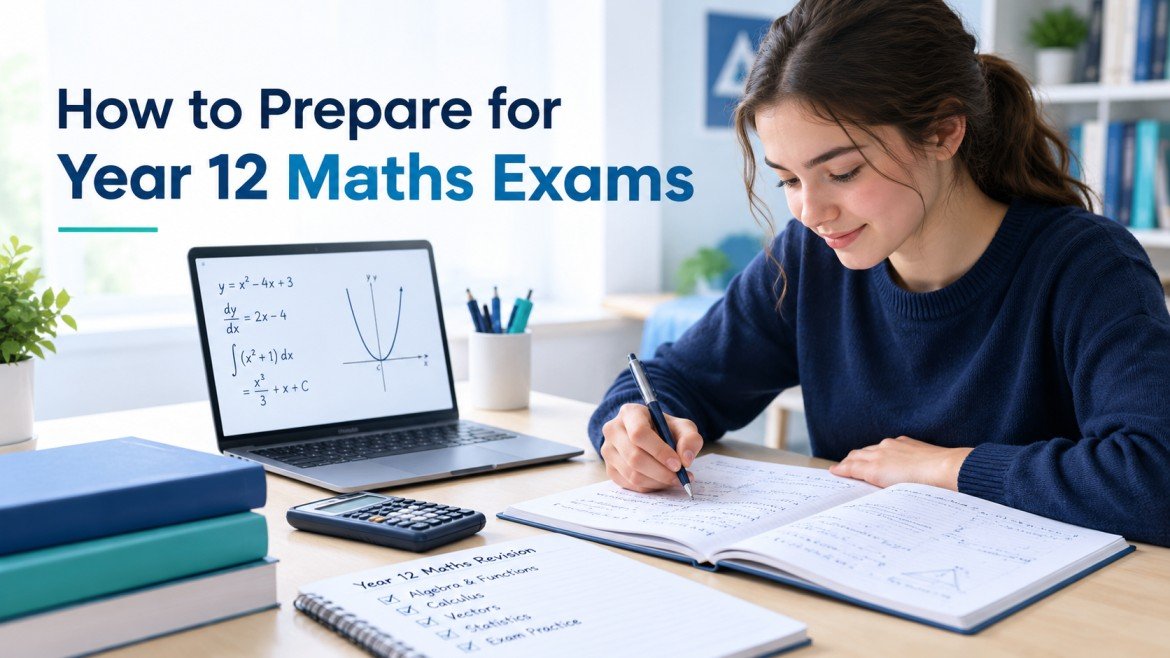
The most effective way to prepare for Year 12 maths exams is to work backwards from your exam date. Confirm your course’s exam format, list every syllabus topic, fix your weakest topics first, then spend the final weeks completing timed past papers and correcting every mark you lose. Practising the way the exam is sat usually helps more than rereading notes.
This guide explains how Year 12 maths exams are structured in different Australian states, how to build a revision plan, how to use past papers properly, and which exam habits protect marks. It applies to students studying Mathematics Advanced or Extension in NSW, Mathematical Methods or Specialist Mathematics in Victoria, Queensland, Western Australia and South Australia, and related senior maths courses.
What Do Year 12 Maths Exams Look Like in Each State?
Every state and territory authority sets its own exam rules, so the first step is to know exactly what you are preparing for. The table below summarises published details from the relevant authorities. Formats can change between years, so always check the current course page before you finalise a study plan.
| Course | How the exam counts | Format details |
| HSC Mathematics Advanced (NSW) | One written HSC exam worth 100 marks | 3 hours plus 10 minutes reading time. Section I has 10 marks of objective response questions and Section II has 90 marks. A NESA reference sheet is provided and NESA approved calculators are allowed. |
| HSC Mathematics Extension 1 (NSW) | One written HSC exam worth 70 marks | 2 hours plus 10 minutes reading time. Section I has 10 multiple choice questions and Section II has 60 marks. |
| VCE Mathematical Methods (Vic) | Exam 1 is 22% and Exam 2 is 44% of the study score. School assessed coursework is the other 34%. | Exam 1 is 1 hour and technology free. Exam 2 is 2 hours and technology active. |
| VCE Specialist Mathematics (Vic) | Exam 1 is 20% and Exam 2 is 40% of the study score | Exam 1 has short answer and extended answer questions. VCAA publishes exam specifications for each exam. |
| QCE General, Methods and Specialist (Qld) | The external exam is 50% of the final subject result | Three internal assessments make up the rest. In Mathematical Methods these are 20%, 15% and 15%. External exams are sat in Term 4. |
| WACE ATAR Methods and Specialist (WA) | School assessment and the WACE exam are combined 50:50 | The Methods exam has calculator free and calculator assumed sections. School marks are moderated against the exam. |
| SACE Stage 2 Mathematical Methods (SA) | External exam is 30% and school assessment is 70% | A 2 hour exam. Electronic technology is required, two unfolded A4 sheets of handwritten notes are permitted and a formula sheet is included in the booklet. |
Two details matter for your study plan. First, check whether your exam has a technology free section, because those questions need fluent algebra and exact values without a calculator. Second, check which formulas are supplied. In NSW, for example, NESA provides a reference sheet for Mathematics Advanced, Extension 1 and Extension 2, so time is better spent learning how to apply formulas than memorising every one.
If you are still deciding between courses, see our guides to HSC Maths Standard vs Advanced and VCE General Maths vs Methods vs Specialist.
Find Out Exactly What Will Be Assessed
Revision is far more efficient when you study the syllabus rather than guess. Start by collecting four things from your teacher or your state authority’s website:
- The syllabus or study design for your course, so you can list every topic and dot point.
- Recent official past papers and any published examiner or assessment reports.
- The exam conditions: reading time, working time, calculator rules and the reference or formula sheet.
- Your school’s assessment schedule, so you can see how coursework and exams fit together.
Then turn the syllabus into a checklist and rate each topic as secure, shaky or not started. Be honest. A topic is only secure if you can solve unseen questions on it without looking at notes.
Build a Revision Timetable Backwards from Your Exam Date
A realistic plan starts with your exam date and works backwards. The structure below is a suggested approach based on common tutoring practice, not an official requirement. Adjust the timing to the number of weeks you actually have.
| Phase | Suggested timing | Main focus |
| Audit | About 8 to 10 weeks before the exam | Complete the topic checklist, sit one past paper to find weak areas and set a weekly study schedule. |
| Repair | About 8 to 4 weeks before | Work through weak topics first, using short daily practice sets. Mix in older topics each week so earlier content is not forgotten. |
| Simulate | About 4 to 1 weeks before | Sit full timed past papers under exam conditions, mark them strictly and fix every lost mark. |
| Sharpen | Final week | Review your error log, formula sheet and common mistakes. Keep sessions shorter and protect your sleep. |
Short, regular sessions usually work better than one long weekend marathon. Forty five minutes of focused problem solving on most days gives you repeated chances to recall methods, which is exactly what the exam demands.
Revise by Solving Problems, Not by Rereading Notes
Reading a worked solution can feel productive because everything makes sense. The exam, however, asks you to produce the solution yourself. Active practice closes that gap. Cover the solution, attempt the question, then compare your working line by line.
The two worked examples below show the kind of reasoning that earns marks in Year 12 calculus and algebra questions.
Use Past Papers the Right Way
Past papers are the closest thing to the real exam, but only if you use them well. Completing a paper and glancing at the answers teaches very little. A stronger method looks like this:
- Attempt a section untimed in your early revision, to learn how questions are phrased.
- Sit full papers under timed conditions in the final weeks, with the same calculator and reference sheet rules as the real exam.
- Mark strictly using official marking guidelines or assessment guides, awarding marks only where your working earns them.
- Record every lost mark in an error log and label it: knowledge gap, method error, careless slip or time pressure.
- Redo the questions you lost marks on a few days later, without looking at the solution.
Official papers are published by NESA for the HSC, the VCAA for the VCE, the QCAA for the QCE, the School Curriculum and Standards Authority for WACE and the SACE Board for South Australia. Using official material also keeps your practice aligned with the current syllabus.
Your error log will quickly reveal patterns. If most lost marks are careless slips, you need checking habits. If they are knowledge gaps, you need targeted revision of that topic. Our guide to common maths exam mistakes and how to avoid them explains the most frequent slips in more detail.
Practise Exam Technique and Time Management
Work out your time per mark
Divide the working time by the total marks to get a pacing guide. In HSC Mathematics Advanced, 3 hours is 180 minutes for 100 marks, which is 1.8 minutes per mark. A 4 mark question therefore deserves roughly 7 minutes. If you are 15 minutes over on one question, it is usually wise to move on and return later. This is a general guide, since easy questions will take less time and extended problems more.
Know your command words
Words such as show that, hence, exact value, justify and prove tell you what the marker is looking for. A question that says “hence” expects you to use the previous result, and an exact answer such as ln 2 will not earn full marks if it is rounded to a decimal.
Show working, especially where marks are awarded for method
Most senior maths papers award marks for method as well as the final answer. A wrong answer with clear working can still collect partial marks, while a correct answer with no working can be difficult to credit in questions that ask you to show reasoning.
Practise both calculator and non calculator skills
If your course has a technology free exam or section, such as VCE Methods Exam 1 or the WACE calculator free section, practise exact values, algebraic manipulation and sketching graphs by hand. If your course allows a graphics or CAS calculator, learn the commands you will actually use and practise with the same model you will take into the exam.
Look After Your Focus and Wellbeing
Preparation is not only about hours of study. Sleep, regular breaks and a steady routine all affect how well you can think under pressure. Plan rest days into your timetable, stop intense revision the night before the exam and prepare your equipment early. If nerves are affecting your performance, our article on how a maths tutor can help with exam anxiety offers practical strategies, and your school wellbeing team can offer support as well.
How Can a Maths Tutor Help You Prepare for Year 12 Exams?
Some students revise effectively alone. Others benefit from an outside perspective, particularly when they are unsure which topics to prioritise or keep losing marks without knowing why. A tutor can mark practice papers strictly, spot recurring error patterns and explain the same concept in a different way.
At Mastering Math Online, Year 12 maths tutoring online is delivered one on one and begins with an assessment of the student’s current understanding, so lessons can target learning gaps and suit the student’s course. We support students across senior pathways including HSC maths tutoring, VCE maths tutoring and QCE maths tutoring, and students who want help understanding how their results feed into university entry can read our overview of how maths affects your ATAR score in every state.
Frequently Asked Questions
When should I start preparing for Year 12 maths exams?
Ideally, you should keep up with coursework from the start of Year 12 and begin structured revision about 8 to 10 weeks before the exam. If you are further behind, start with your weakest topics now, because focused revision still helps even when time is short.
How many past papers should I do?
There is no official number. Quality matters more than quantity. One paper that you mark strictly, analyse and redo is worth more than several papers you only skim. Use as many official papers as are available for your course.
Do I need to memorise formulas?
It depends on your course. Check the exam conditions for your subject. NESA supplies a reference sheet for HSC Mathematics Advanced, Extension 1 and Extension 2, and SACE includes a formula sheet in the Mathematical Methods exam booklet. Even when formulas are provided, you still need to know when and how to apply them.
Is it too late to improve in the final weeks?
Many students can still lift their performance by fixing specific weaknesses and learning better exam habits, but no study plan can guarantee a particular result. The most useful approach is to target the topics where you are losing the most marks.
How is preparing for Year 12 General Mathematics different from Methods or Advanced?
The study method is the same: audit, repair, simulate and review. The content differs, with General Mathematics typically focusing on areas such as statistics, financial mathematics and matrices, while Methods and Advanced have a stronger focus on functions and calculus. Always revise from the syllabus for your exact course.