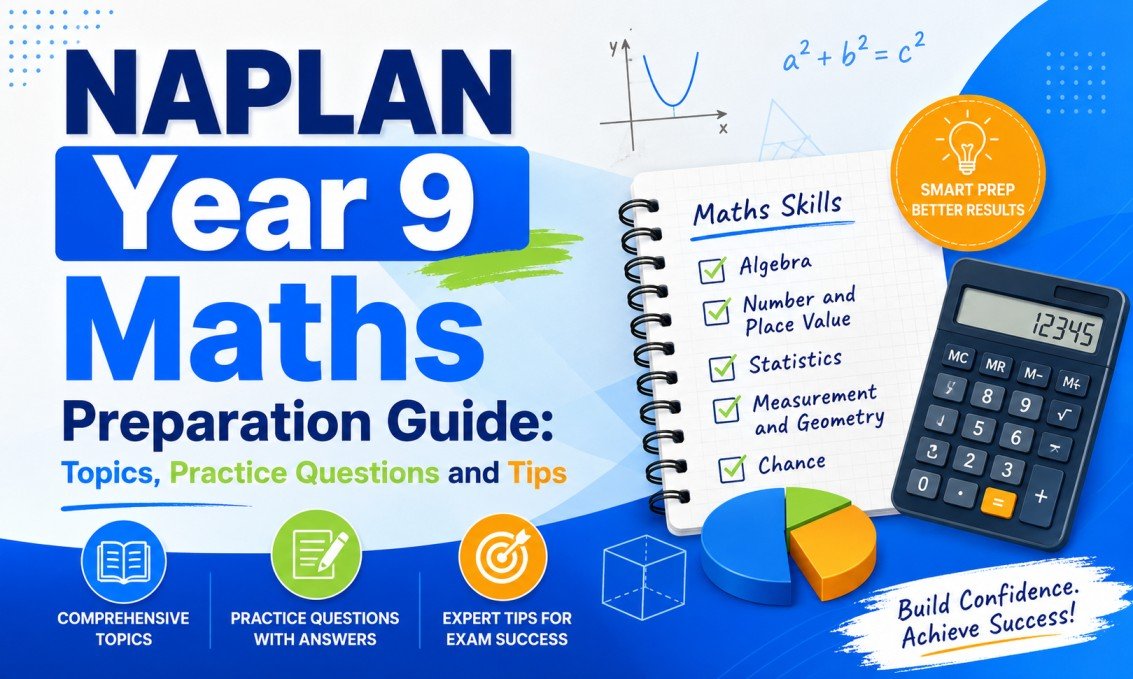


NAPLAN maths, officially called the Numeracy test, checks how well Australian students in Years 3, 5, 7 and 9 can use number skills, measurement, geometry, and data handling to solve real problems, not just recall facts. Understanding what the test actually covers and how it is structured for each year level, is the first step to helping a child feel confident rather than caught off guard. This guide breaks down the Numeracy test topic by topic and outlines simple, evidence-based ways to prepare, drawn from what actually helps students at Mastering Maths Online improve their results year after year.
What Is NAPLAN Numeracy?
NAPLAN Numeracy is one of four domains in the National Assessment Program, alongside Reading, Writing and Language Conventions. It is delivered online for Years 5, 7 and 9, with adaptive questions that adjust in difficulty based on how a student is answering. Year 3 also sits the Numeracy test online, though its writing component remains on paper.
The test is not designed to catch students out with tricky wording. Instead, it measures whether students can apply the maths they already learn in class to everyday situations, such as working out change, reading a timetable, or interpreting a simple graph.
What Does NAPLAN Maths Actually Test?
The Numeracy test is built around three broad strands of the Australian Curriculum. Each strand shows up across all year levels, just with increasing complexity.
Number and Algebra
This strand covers whole numbers, fractions, decimals, percentages, ratios, and simple algebraic patterns. Younger students might be asked to order numbers or complete a number pattern, while Year 9 students tackle multi step problems involving percentages, proportions, and basic equations.
Measurement and Geometry
Questions here involve units of measurement, area, perimeter, volume, angles, and shape properties. A typical question might ask a student to calculate how much fencing is needed for a backyard, or to identify the properties of a triangle.
Statistics and Probability
Students interpret graphs, tables and charts, and answer questions on chance and likelihood. This strand often trips students up not because the maths is hard, but because reading the graph correctly takes practice.
How the Numeracy Test Is Structured by Year Level
The format changes slightly as students move through school:
- Year 3 and Year 5: one Numeracy section, calculators are not used, and questions focus on foundational number sense and simple problem solving.
- Year 7 and Year 9: the Numeracy test is split into a non calculator section followed by a calculator allowed section, and once a student moves into the calculator section they cannot go back.
- All year levels: questions move from multiple choice to short answer and drag and drop formats as students progress through the online test.
- Test length ranges from around 45 to 65 minutes depending on year level, so pacing matters as much as accuracy.
| Quick fact Calculators are never allowed in the Numeracy sections for Year 3 and Year 5, and only in the second half of the Year 7 and Year 9 tests. Strong mental maths is essential at every year level. |
How to Prepare for NAPLAN Maths
Cramming in the weeks before NAPLAN rarely helps. The students who feel calm and perform well are usually those who have built steady numeracy habits across the year. These are the strategies that consistently make the biggest difference.
Build daily numeracy habits
Short, regular practice beats long, irregular sessions. Ten to fifteen minutes a day on mixed topics such as fractions, measurement, and data reading keeps concepts fresh without creating pressure.
Practise mental maths without a calculator
Since Year 3 and Year 5 never use a calculator, and Year 7 and Year 9 face a non calculator section first, mental strategies for addition, multiplication, and estimation need to become second nature well before test day.
Focus on word problems
Most NAPLAN maths questions are written as short real world scenarios. Students who struggle usually understand the maths but stumble on translating the words into a calculation. Practising how to pull out the key numbers from a worded question builds this skill directly.
Use official style practice tests
Sitting a practice test in the same online, adaptive format helps students get comfortable with drag and drop questions, on screen working, and time pressure, so none of it feels unfamiliar on the day.
Get targeted support where needed
A qualified NAPLAN math tutor can quickly identify which strand, whether it is fractions, geometry, or data interpretation, is holding a student back, and focus practice there rather than revising everything equally. This is often the fastest way to lift results without adding stress.
Conclusion
NAPLAN maths is ultimately a check in on how well students can apply the number, measurement, and data skills they are already learning at school. It rewards steady practice far more than last minute cramming. By understanding what each strand covers and building small, consistent habits around mental maths and word problems, students can walk into the test with genuine confidence rather than anxiety. If your child needs extra support in a specific area, personalised tutoring can help close the gap quickly and build lasting number confidence well beyond the test itself.
NAPLAN Numeracy covers number and algebra, measurement and geometry, and statistics and probability, all applied through real world style questions.
Year 3 and Year 5 do not use a calculator at all. Year 7 and Year 9 complete a non calculator section first, followed by a calculator allowed section.
It runs for approximately 45 to 65 minutes, depending on the student’s year level.
Encourage short, regular practice on mixed topics, build confidence with mental maths, and use word problems to connect classroom maths to everyday situations.
No. NAPLAN is a diagnostic snapshot of literacy and numeracy progress and does not count toward school grades, ATAR, or university admission.