
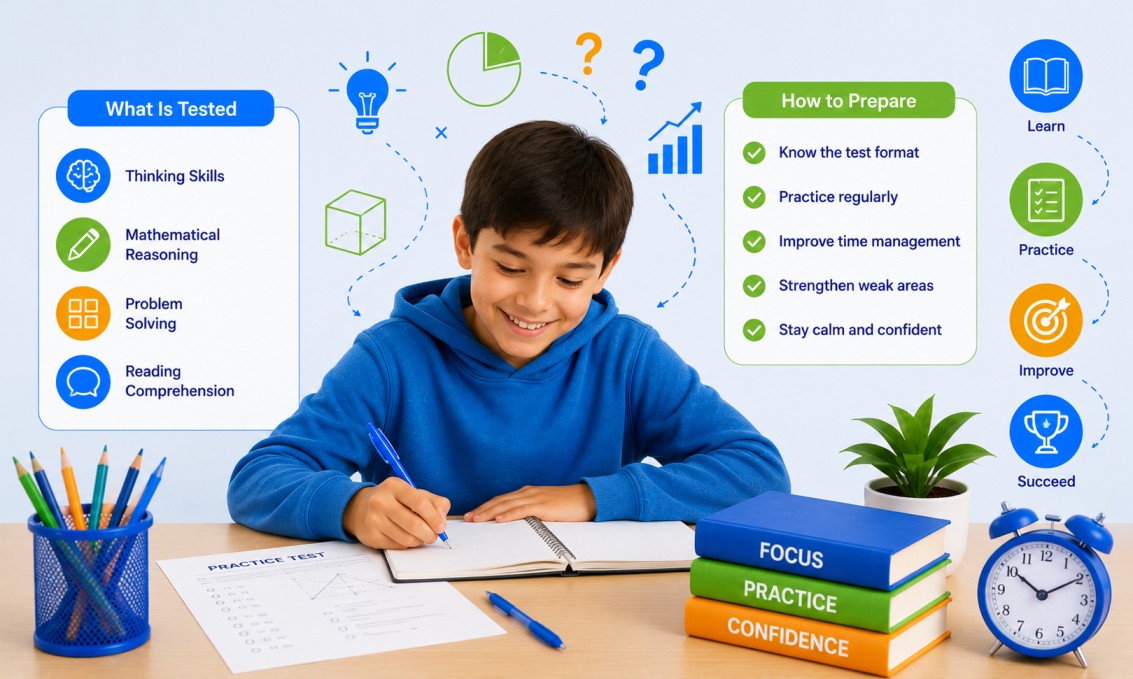
Getting a place at an academically selective high school starts with one test, and understanding it properly is the best head start a family can give their child. In New South Wales, the Selective High School Placement Test is a computer based assessment sat in Year 6, made up of four equally weighted sections: Reading, Mathematical Reasoning, Thinking Skills and Writing. Around 17,000 students compete each year for roughly 4,200 places, so the test is designed to separate students on reasoning ability rather than memorised knowledge. This guide breaks down exactly what each section covers, how the test is structured, and the preparation approach that genuinely improves results.
What the Selective School Test Involves
The test measures how a child thinks, reads and communicates under time pressure, not how much content they can recall. Every section is multiple choice except Writing, and the whole test runs for around two and a half hours across one sitting at a designated test centre.
Section Overview
- Reading, 45 minutes, around 17 questions covering fiction, nonfiction and poetry
- Mathematical Reasoning, 40 minutes, around 35 multiple choice questions, no calculator
- Thinking Skills, 40 minutes, around 40 multiple choice questions covering verbal and non verbal reasoning
- Writing, 30 minutes, one typed response to a set prompt
Each section contributes 25 per cent of the final scaled score, so no single strength can carry a weak result elsewhere. A student who excels at maths but struggles with reading still needs a solid result across the board.
Reading
The Reading section tests comprehension, inference and the ability to interpret tone and meaning across a range of text types, including fiction, nonfiction and poetry. Some questions are multi part, so a single passage can generate several separate answers.
What Helps
- Regular exposure to varied text types, not just novels
- Practice identifying the main idea versus supporting detail
- Comfort with inference questions where the answer is implied rather than stated directly
Mathematical Reasoning
This section does not test how fast a child can calculate. It tests whether they can apply mathematical understanding to an unfamiliar problem, often wrapped inside a wordy scenario, without using a calculator.
Core Content Areas
- Fractions, decimals, percentages and ratio problems
- Number patterns and simple algebraic reasoning
- Area, perimeter, angles and other geometry questions
- Reading and interpreting graphs, tables and data
The content itself sits within the Year 5 and Year 6 curriculum. The challenge comes from how questions are framed and the strict time limit of roughly a minute per question.
Thinking Skills
Thinking Skills requires no prior subject knowledge, which makes it feel unfamiliar to many students at first. It blends verbal reasoning, such as argument analysis and logical puzzles, with non verbal reasoning, such as pattern matrices and figure sequences.
Why It Trips Students Up
- No curriculum content to fall back on, so pure logic matters most
- Question types rarely appear in normal classroom work
- Abstract patterns require sustained concentration under time pressure
Because this section is so different from regular schoolwork, even strong academic students benefit from dedicated practice with this specific question style.
Writing
Students type a single response to a set prompt within 30 minutes. Markers are looking for how well a student selects, develops and organises ideas, and communicates them clearly for the given purpose and audience.
What Strong Responses Share
- A clear structure with a defined beginning, middle and end
- Ideas that are developed in depth rather than simply listed
- Controlled spelling, punctuation and grammar under time pressure
How This Test Differs From Normal School Assessment
Selective test questions are not necessarily harder in terms of content. What makes them demanding is the way they are framed. Rather than recalling learned material, a child needs to apply reasoning to something genuinely unfamiliar, working through several skills at once within a tight time limit.
This is precisely why a student who performs well in class can still find the format challenging without preparation, and why targeted practice makes such a measurable difference.
How to Prepare Effectively
Understand the Format Early
Familiarity with question types and timing removes a significant amount of test day anxiety. A child who already knows what to expect can focus entirely on the problem in front of them.
Practise Under Timed Conditions
Untimed practice builds knowledge but not exam readiness. Regular timed sessions build the speed and composure the real test demands.
Balance All Four Sections
It can be tempting to focus only on a child’s weaker area, but because each section carries equal weight, consistent effort across Reading, Mathematical Reasoning, Thinking Skills and Writing produces the strongest overall result.
Review Mistakes Properly
Working through why an answer was wrong, not just what the correct answer was, builds the reasoning skills the test is designed to assess.
Maintain a Sustainable Pace
Short, regular sessions over several months consistently outperform last minute cramming. A well rested, confident child typically performs better than one who is exhausted from an intense final push.
How Mastering Maths Online Can Help
At Mastering Maths Online, our tutors support students across every Australian state and territory with selective test preparation that goes beyond content revision. We focus on building the reasoning, problem solving and time management skills each section actually rewards, with regular feedback that keeps children improving steadily rather than cramming under pressure. Our goal is a confident, well prepared student on test day, not just a well drilled one.
Conclusion
The selective school test rewards reasoning, careful reading and clear thinking under time pressure across four equally weighted sections. Understanding exactly what each section involves is the first step toward genuine readiness. Consistent, targeted practice over several months, rather than a rushed final effort, is what turns that understanding into a strong result on test day.
Frequently Asked Questions
Four sections: Reading, Mathematical Reasoning, Thinking Skills and Writing, each worth 25 per cent of the final score.
No. All sections, including Mathematical Reasoning, must be completed without a calculator.
No. Thinking Skills tests logical and abstract reasoning rather than curriculum content, so no specific subject knowledge is required.
Not on its own. The test rewards reasoning and application under time pressure, so students also need practice with the specific question formats used.
Most families see the best results starting six to twelve months ahead with short, regular sessions rather than intensive study close to test day.