
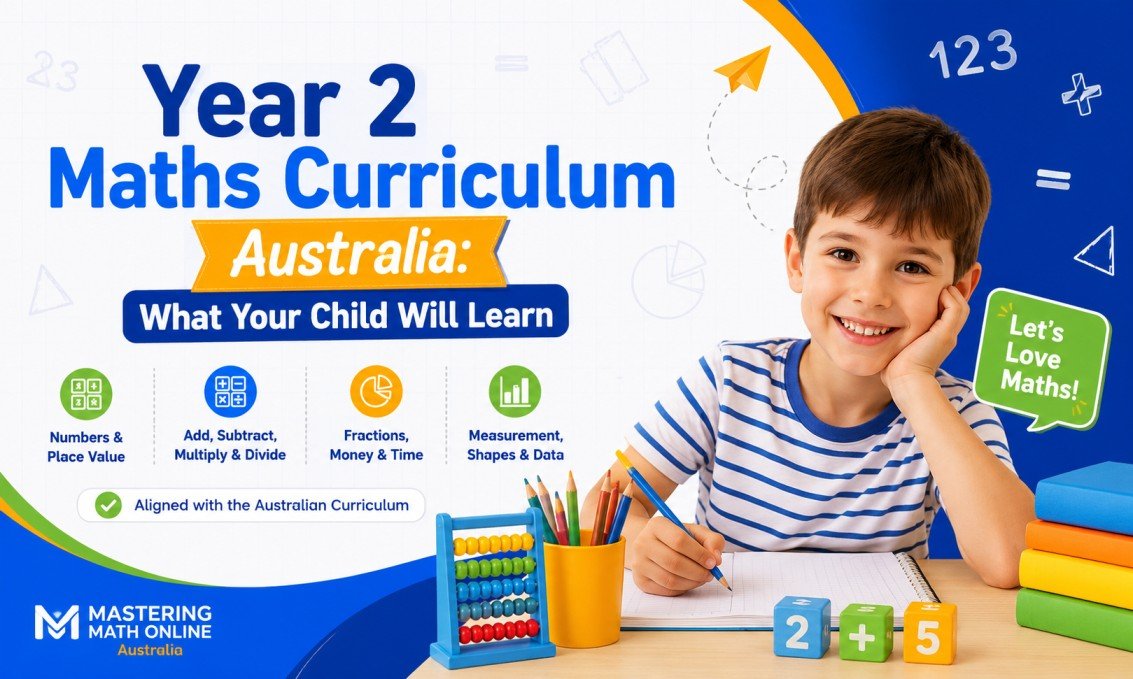
Starting Year 2 is an important step in a child’s mathematical development. At this stage, children begin moving beyond basic counting and simple calculations and start developing a deeper understanding of numbers, patterns, measurement, money, shapes, time and problem-solving.
For Australian parents, it can sometimes be difficult to know exactly what a Year 2 child is expected to learn. The year 2 mathematic Australian Curriculum provides a framework for the mathematical knowledge and skills students develop during primary school, but children do not all learn at exactly the same pace.
In this guide, we explain the key Year 2 maths topics in Australia, the skills your child is expected to develop, and practical ways you can support their learning at home.
Year 2 Maths Topics Your Child Will Learn
There are several important areas of mathematics that Year 2 students work on throughout the school year. Some children will find certain topics easier than others, so regular practice and encouragement can make a big difference.
1. Number and Place Value
Understanding numbers is one of the most important parts of Year 2 maths.
Children develop their understanding of numbers up to at least 1,000. They learn how numbers are structured and how hundreds, tens and ones work together.
Your child may learn to:
- Read and write numbers up to 1,000
- Count forwards and backwards
- Compare and order numbers
- Identify hundreds, tens and ones
- Partition numbers into different parts
- Rearrange and rename numbers
- Recognise number patterns
- Use number lines and other visual representations
For example, a child might learn that 347 can be represented as 300 + 40 + 7.
This understanding of place value becomes extremely important as maths becomes more challenging in later primary school.
2. Addition and Subtraction
Year 2 students continue developing their addition and subtraction skills and begin using different strategies rather than relying only on counting.
They may practise:
- Addition and subtraction facts
- Mental maths strategies
- Adding and subtracting two-digit numbers
- Breaking numbers into smaller parts
- Using number lines
- Checking whether an answer is reasonable
- Solving addition and subtraction word problems
The Australian Curriculum achievement standard includes proficiency with addition and subtraction facts within 20. Students also use mathematical modelling to solve practical additive problems.
For example:
Mia has 28 stickers and receives 15 more. How many stickers does she have altogether?
The important part is not simply knowing that 28 + 15 = 43. Children should gradually understand why the calculation works and be able to explain their thinking.
3. Early Multiplication and Division
Multiplication and division are introduced through practical situations such as equal groups, sharing and repeated addition.
At this stage, children may work with:
- Equal groups
- Repeated addition
- Sharing objects equally
- Simple multiplication problems
- Groups of 2
- Skip counting
- Simple division situations
Year 2 students are expected to develop proficiency with multiplication facts for twos.
For example:
There are 4 bags with 2 apples in each bag. How many apples are there altogether?
Children can solve this by thinking:
2 + 2 + 2 + 2 = 8
and gradually connect this to:
4 × 2 = 8.
Building this understanding early makes future multiplication and division learning much easier.
4. Fractions
Fractions may seem complicated at first, but Year 2 students are introduced to simple fractions through familiar objects and everyday situations.
Children learn about part-whole relationships, including:
- Halves
- Quarters
- Eighths
For example, cutting a sandwich into four equal pieces can help a child understand that each piece represents one-quarter.
Students also begin recognising that the parts need to be equal when representing a fraction.
The Australian Curriculum Year 2 achievement standard specifically includes halves, quarters and eighths in measurement contexts.
Parents can make fractions easier by using everyday examples such as sharing food, dividing toys into groups or folding paper into equal parts.
5. Australian Money
Money is another important part of Year 2 mathematics because it connects maths with real-life situations.
Children may learn to:
- Recognise Australian coins and notes
- Identify the value of different coins
- Compare amounts
- Combine different coins
- Solve simple money problems
- Work through basic transactions
For example:
A toy costs $6. If you have $10, how much money will you have left?
These practical problems help children understand why addition and subtraction are useful outside the classroom.
Money problems are also included within the Year 2 Australian Curriculum achievement standard.
6. Measurement
Year 2 students develop their understanding of measurement by comparing and measuring objects using appropriate units.
Depending on the learning activity, children may explore:
- Length
- Height
- Area
- Capacity
- Mass
- Comparing objects
- Using informal units to measure
For example, a child might compare the length of two pencils or measure the length of a table using blocks.
The Australian Curriculum expects Year 2 students to use uniform informal units to measure and compare shapes and objects.
Hands-on activities can be particularly useful here because children can physically see and compare the measurements they are learning about.
7. Time and Calendars
Year 2 is an important stage for developing confidence with time.
Children learn to read an analogue clock to:
- The hour
- Half-hour
- Quarter-hour
They may also learn to use calendars and determine the number of days between events.
For example:
If today is Monday and your birthday is on Thursday, how many days are there until your birthday?
Parents can practise time naturally by asking questions about school schedules, meal times, bedtime or weekend activities.
8. Shapes, Space and Position
Year 2 maths also includes spatial thinking.
Children explore different shapes and learn to describe their characteristics. They may also develop their understanding of position, direction and movement.
Activities can include:
- Identifying 2D shapes
- Exploring 3D objects
- Describing shapes
- Comparing shapes
- Following directions
- Describing position
- Exploring pathways and locations
Using blocks, puzzles and household objects can make these concepts much more engaging than simply looking at pictures in a workbook.
9. Patterns and Early Algebraic Thinking
Patterns help children develop logical thinking and prepare them for more advanced algebra later on.
In Year 2, students may work with patterns that:
- Increase by a constant amount
- Decrease by a constant amount
- Have missing elements
- Follow a simple rule
For example:
5, 10, 15, 20, __
The child needs to identify the rule and determine that the missing number is 25.
The Australian Curriculum specifically includes increasing and decreasing additive patterns and identifying missing elements in Year 2.
10. Data and Simple Graphs
Children also begin collecting, organising and interpreting simple information.
For example, a class might ask:
What is your favourite fruit?
Students can collect the answers and organise them into a table or graph.
They can then answer questions such as:
- Which fruit was the most popular?
- Which was the least popular?
- How many students chose apples?
- How many more students chose apples than bananas?
These activities develop early data literacy and help children understand how information can be represented visually.
What Should a Year 2 Child Know in Maths?
By the end of Year 2, children should be developing confidence across several core areas of mathematics.
A child working towards the Year 2 achievement standard should be developing the ability to:
- Work with numbers to at least 1,000
- Understand hundreds, tens and ones
- Partition and rearrange numbers
- Use addition and subtraction strategies
- Recall addition and subtraction facts within 20
- Understand simple multiplicative situations
- Recall multiplication facts for twos
- Solve practical maths problems
- Recognise halves, quarters and eighths
- Work with Australian money
- Measure and compare objects
- Read an analogue clock to the hour, half-hour and quarter-hour
- Use a calendar to work out days between events
- Recognise and continue simple patterns
- Work with shapes and spatial ideas
- Collect and interpret simple data
These expectations come from the Australian Curriculum’s Year 2 mathematics achievement standard.
It is important to remember that children develop at different rates. A child who needs more practice with one area does not necessarily mean they are “bad at maths”.
How Can Parents Help With Year 2 Maths at Home?
You do not need to turn your home into a classroom to help your child develop stronger maths skills.
Small everyday activities can provide excellent opportunities to practise mathematical thinking.
Use Shopping to Practise Money
When you go shopping, ask your child to identify coins, compare prices or work out how much change might be needed.
Use Cooking to Practise Measurement and Fractions
Cooking provides natural opportunities to talk about halves, quarters, measurement and capacity.
Use a Clock to Practise Time
Ask your child questions such as:
“What time do we leave for school?”
or:
“How long until dinner?”
Play Number Games
Simple card games, dice games and number challenges can help children practise counting, addition and number patterns without making learning feel like homework.
Look for Maths in Everyday Life
You can ask questions while walking, travelling or playing:
- How many cars can you see?
- Which object is longer?
- How many groups of two can we make?
- What shape is this sign?
- How many days until the weekend?
These short conversations can help children understand that maths is something they use every day.
Common Year 2 Maths Challenges for Children
Some children find particular areas of Year 2 mathematics more difficult than others.
Common challenges can include:
- Confusion about place value
- Difficulty adding or subtracting two-digit numbers
- Counting repeatedly instead of using efficient strategies
- Difficulty understanding equal groups
- Confusion between halves and quarters
- Trouble reading an analogue clock
- Difficulty understanding money problems
- Struggling with maths word problems
- Finding patterns difficult to identify
- Lack of confidence when explaining mathematical thinking
Sometimes the issue is not the maths concept itself but the way it has been explained.
For example, a child may be able to calculate 8 + 7 but struggle when the same calculation appears in a word problem.
This is why building mathematical reasoning and problem-solving skills is just as important as practising calculations.
When Should You Consider Extra Maths Support?
If your child occasionally makes mistakes, there is usually no reason to worry. Mistakes are a normal part of learning.
However, additional support may be useful if your child consistently:
- Avoids maths activities
- Becomes frustrated with simple problems
- Has difficulty understanding concepts taught repeatedly
- Struggles to keep up with classroom work
- Finds maths homework particularly stressful
- Lacks confidence when answering questions
- Needs significantly more time than expected to complete basic calculations
Early support can be helpful because mathematical concepts build on one another.
A gap in place value, for example, can make later addition, subtraction and multiplication more difficult.
How Can Year 2 Maths Tutoring Help?
Every child learns differently. Some children need additional explanation, some need more practice, while others benefit from being challenged beyond their classroom work.
At Year 2 Maths Tutoring Australia, lessons can be tailored around a child’s current skills, learning pace and areas of difficulty.
At Mastering Math Online, our online primary school maths tutoring is designed to provide personalised one-to-one support aligned with the Australian Curriculum.
A personalised lesson can focus on areas such as:
- Number and place value
- Addition and subtraction
- Early multiplication
- Fractions
- Money
- Measurement
- Time
- Patterns
- Shapes
- Word problems
- Mathematical reasoning
The goal is not simply to give children more worksheets. Effective tutoring should help them understand the idea behind a question, practise it with guidance and gradually become more independent.
Why Strong Year 2 Maths Foundations Matter
Year 2 may seem early in a child’s school journey, but the mathematical ideas introduced at this stage become building blocks for future learning.
Place value supports larger numbers and calculations.
Addition and subtraction strategies support more complex problem-solving.
Early multiplication prepares children for multiplication facts and division.
Fractions become important when children later study decimals, percentages and ratios.
Measurement, time, shapes and data also become increasingly sophisticated throughout primary and secondary school.
This is why helping children develop understanding and confidence in maths is more valuable than simply encouraging them to memorise answers.