
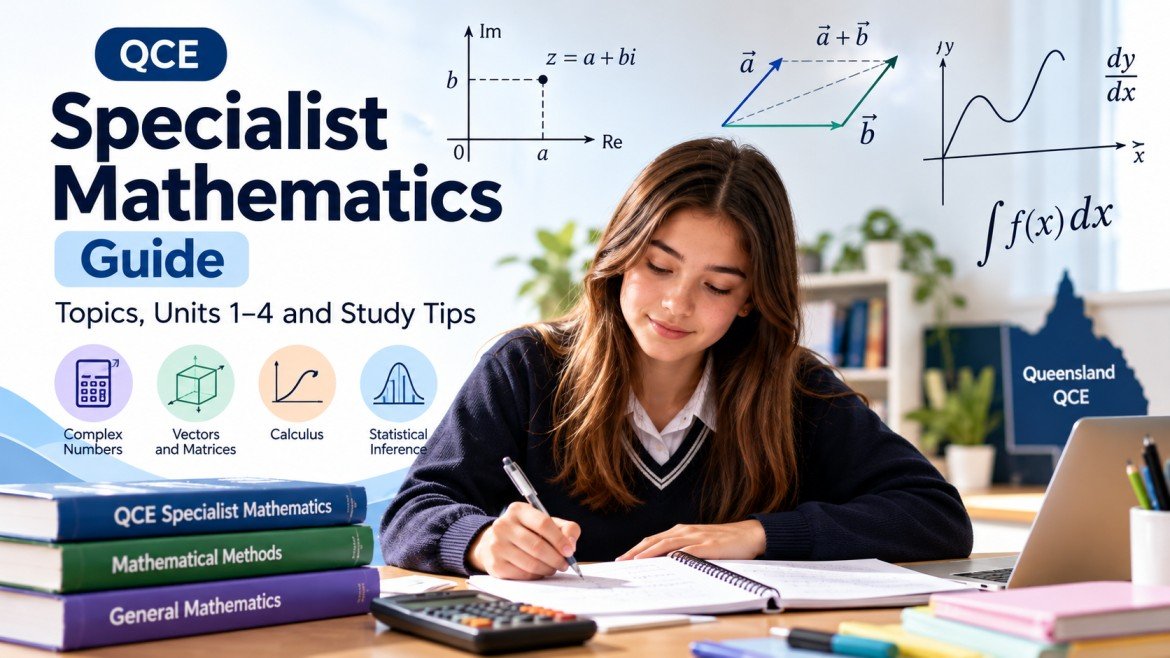
QCE Specialist Mathematics is one of Queensland’s most advanced senior secondary mathematics subjects. It challenges Year 11 and Year 12 students to explore complex numbers, vectors, matrices, mathematical proof, advanced calculus and statistical inference.
This QCE Specialist Mathematics guide explains what you study in Units 1–4, how assessments work, which topics students often find challenging and how to prepare effectively.
For students and parents who are still comparing Queensland mathematics pathways, our QCE Maths Subjects Explained article provides a broader introduction.
QCE Specialist Mathematics Units 1–4: Complete Topic Overview
The QCAA Specialist Mathematics syllabus contains four units, each with a different focus.
| Unit | Official unit title | Main areas |
|---|---|---|
| Unit 1 | Combinatorics, proof, vectors and matrices | Counting techniques, mathematical proof, vectors and matrices |
| Unit 2 | Complex numbers, further proof, trigonometry, functions and transformations | Complex numbers, advanced trigonometry, functions and proof |
| Unit 3 | Further complex numbers, proof, vectors and matrices | Extended complex-number techniques, vectors, matrices and mathematical reasoning |
| Unit 4 | Further calculus and statistical inference | Advanced calculus, differential equations and statistical inference |
These unit titles follow the QCAA Specialist Mathematics 2025 v1.4 syllabus.
Unit 1: Combinatorics, Proof, Vectors and Matrices
Unit 1 introduces several mathematical ideas that students may not have studied in depth during Year 10.
Combinatorics
Combinatorics involves counting the number of possible arrangements or selections without listing every possibility individually.
Students learn techniques that can be applied to probability and more complex mathematical problems.
Mathematical proof
Proof involves demonstrating why a mathematical statement is true using logical arguments.
Unlike questions that only require a numerical answer, proof questions require students to justify their reasoning clearly.
Vectors
Vectors represent quantities with both magnitude and direction.
They are particularly useful in geometry, physics and mathematical modelling.
Matrices
Matrices organise numbers into rectangular arrays and support mathematical operations and transformations.
Study tip: Spend extra time understanding mathematical notation. Many students can perform calculations but lose confidence when they encounter unfamiliar symbols.
Unit 2: Complex Numbers, Further Proof, Trigonometry, Functions and Transformations
Unit 2 develops more abstract mathematical concepts.
Complex numbers
Complex numbers extend the real number system by introducing the imaginary unit:
[
i=\sqrt{-1}
]
More precisely, (i) is defined by the property:
[
i^2=-1
]
A complex number can be written as:
[
z=a+bi
]
where (a) and (b) are real numbers.
Further proof
Students extend their reasoning skills and practise constructing logically valid mathematical arguments.
Trigonometry
Trigonometric knowledge is extended beyond introductory right-angled triangle calculations.
Functions and transformations
Students investigate mathematical functions and how transformations affect their graphs and properties.
Study tip: Revise algebra and trigonometry regularly. Weaknesses in these foundational areas can make advanced mathematical problems significantly harder.
Unit 3: Further Complex Numbers, Proof, Vectors and Matrices
Unit 3 extends mathematical ideas introduced in Year 11.
Students apply more sophisticated techniques involving complex numbers, mathematical proof, vectors and matrices.
A major challenge is learning to connect different topics within a single problem.
For example, a question may require students to interpret a vector geometrically, use algebraic techniques and justify their conclusions.
Study tip: Practise unfamiliar questions rather than only repeating examples from your textbook. Explain why each mathematical method is appropriate.
Unit 4: Further Calculus and Statistical Inference
Unit 4 focuses on advanced calculus and statistical reasoning.
Further calculus
Students extend their understanding of differentiation and integration, including applications involving differential equations.
Differential equations
Differential equations describe relationships involving a function and its derivatives.
They are important in mathematical models of physical processes such as growth, motion and change.
Statistical inference
Students investigate how mathematical and statistical methods can be used to draw conclusions from data.
Study tip: Connect each new calculus technique to what you already know from Mathematical Methods. Understanding the relationship between a function and its derivative is more valuable than memorising isolated procedures.
QCE Specialist Mathematics Worked Examples
The following original examples demonstrate important mathematical ideas from the Specialist Mathematics course. They are instructional examples rather than questions taken from official QCAA examinations.
Example 1: Combinatorics — How Many Arrangements Are Possible?
Question: Five different mathematics textbooks are arranged on a shelf. How many different orders are possible?
Step 1: Identify the number of choices.
There are five choices for the first position, four for the second, three for the third, two for the fourth and one for the fifth.
Step 2: Multiply the possibilities.
[
5\times4\times3\times2\times1=5!
]
Step 3: Calculate.
[
5!=120
]
Answer: There are 120 different arrangements.
This example illustrates the multiplication principle and factorial notation used in combinatorics.
Example 2: Complex Numbers — Multiply Two Complex Numbers
Question: Simplify:
[
(3+2i)(1-4i)
]
Step 1: Expand the brackets.
[
=3-12i+2i-8i^2
]
Step 2: Use (i^2=-1).
[
=3-10i+8
]
Step 3: Combine like terms.
[
=11-10i
]
Answer:
[
\boxed{11-10i}
]
Common mistake: Forgetting that (i^2=-1). This can produce an incorrect real component.
Example 3: Vectors — Find the Magnitude
Question: A vector is given by:
[
\mathbf{v}=\begin{pmatrix}6\8\end{pmatrix}
]
Find its magnitude.
Step 1: Apply the magnitude formula.
[
|\mathbf{v}|=\sqrt{x^2+y^2}
]
Step 2: Substitute the components.
[
|\mathbf{v}|=\sqrt{6^2+8^2}
]
[
=\sqrt{36+64}
]
Step 3: Simplify.
[
|\mathbf{v}|=\sqrt{100}=10
]
Answer: The vector has a magnitude of 10 units.
This concept becomes useful in more advanced vector problems involving direction, geometry and physical quantities.
Example 4: Differential Equations — Find a Function
Question: A function satisfies:
[
\frac{dy}{dx}=6x
]
Given that (y=5) when (x=1), find (y) in terms of (x).
Step 1: Integrate both sides.
[
y=\int 6x,dx
]
[
y=3x^2+C
]
Step 2: Use the initial condition.
When (x=1), (y=5):
[
5=3(1)^2+C
]
[
C=2
]
Step 3: Write the final function.
[
\boxed{y=3x^2+2}
]
Check: Differentiating (3x^2+2) gives (6x), and substituting (x=1) gives (y=5).
This introductory example shows how integration and initial conditions can be used to solve a simple differential equation.
How Is QCE Specialist Mathematics Assessed?
Understanding the assessment structure helps students prepare for the different skills required in internal and external assessments.
Under the QCAA Specialist Mathematics 2025 syllabus, students complete three summative internal assessments and one external assessment in Units 3 and 4.
| Assessment | Type | Weight |
|---|---|---|
| IA1 | Problem-solving and modelling task | 20% |
| IA2 | Short-response examination | 15% |
| IA3 | Short-response examination | 15% |
| External Assessment (EA) | QCAA examination | 50% |
| Total | 100% |
Units 1 and 2 are assessed formatively and help students develop the knowledge needed for later units.
What Is the Specialist Mathematics External Examination?
The QCAA external assessment contributes 50% of the final subject result.
It contains two papers:
Paper 1 — Technology-free
- Contributes 25% of the overall subject result.
- Tests mathematical knowledge without calculator assistance.
- Requires accurate algebraic manipulation, reasoning and problem-solving.
Paper 2 — Technology-active
- Contributes 25% of the overall subject result.
- Allows specified approved technology.
- Tests students’ ability to use mathematics and technology appropriately.
Both papers assess content from Units 3 and 4, while assuming relevant knowledge from earlier units and Mathematical Methods.
Students should check the latest QCAA assessment conditions and approved calculator information before their examination.
Why Do Students Find QCE Specialist Mathematics Difficult?
Specialist Mathematics is challenging because students must combine mathematical techniques with deeper reasoning.
The difficulty does not come only from longer calculations.
1. Abstract Mathematical Concepts
Complex numbers, proof and advanced vector concepts may feel unfamiliar at first.
Students need to understand the meaning of the mathematics, not just memorise procedures.
2. Strong Dependence on Algebra
Many Specialist problems require confident algebraic manipulation.
A small error in expanding brackets, simplifying expressions or rearranging equations can affect the entire solution.
3. Connections Between Different Topics
A single question may combine vectors, functions, calculus or proof.
Students must recognise which techniques are relevant and how they fit together.
4. Mathematical Communication
QCAA assessments require students to communicate and justify mathematical reasoning.
A correct numerical answer may not demonstrate all the reasoning required by a question.
5. Time Pressure
Students must solve unfamiliar problems efficiently under examination conditions.
This requires practice, planning and familiarity with assessment formats.
Eight Practical Study Tips for QCE Specialist Mathematics
1. Strengthen Your Mathematical Methods Foundations
Specialist Mathematics assumes knowledge from Methods.
Regularly revise:
- Algebraic manipulation
- Functions and graphs
- Trigonometry
- Differentiation
- Integration
- Probability and statistics
If you are finding these topics difficult, our QCE Maths Methods Preparation Guide provides additional study guidance.
2. Understand the Concept Before Memorising a Formula
Ask yourself what a formula represents, why it works and when it can be applied.
For example, when learning vector magnitude, understand its relationship to the Pythagorean theorem rather than memorising the expression alone.
3. Maintain a Mistake Log
After each practice session, record the errors you made.
A useful mistake log contains:
| Mistake | Possible cause | Improvement |
|---|---|---|
| Incorrect complex-number sign | Forgot (i^2=-1) | Review powers of (i) |
| Incorrect vector magnitude | Calculation error | Check squares and square roots |
| Incomplete proof | Missing justification | Practise logical explanation |
| Wrong integration constant | Initial condition not applied | Substitute known values |
Review this log every week.
4. Practise Technology-Free Questions
Do not become dependent on a graphics calculator.
Practise simplifying expressions, solving equations and performing exact calculations without technology.
This is especially important for Paper 1 of the external assessment.
5. Learn to Use Approved Technology Effectively
For technology-active tasks, practise using your approved calculator to check results, explore graphs and solve suitable problems.
However, technology should support your mathematical understanding rather than replace it.
6. Use QCAA Past Papers Strategically
The QCAA provides past papers, sample assessment instruments and marking guides.
Begin with questions from topics you have already studied.
Then progress towards mixed-topic practice under timed conditions.
Important: Some older papers were developed under earlier syllabus versions. Compare them with the current syllabus before assuming every question reflects the latest assessment requirements.
7. Explain Your Mathematical Reasoning
After solving a problem, explain your method in complete mathematical statements.
For example, instead of writing only a derivative and an answer, explain why setting the derivative equal to zero identifies a stationary point and how you determined its nature.
8. Review Consistently Throughout the Year
Avoid leaving revision until the weeks before an examination.
A short, consistent routine is more manageable than trying to relearn several units at once.
This plan provides approximately four hours of structured independent study per week, excluding optional Sunday revision.
Adjust it according to school homework, assessment deadlines, other subjects and individual learning needs.
How to Prepare for the QCE Specialist Mathematics External Exam
External examination preparation should be systematic.
Step 1: Review the Current QCAA Syllabus
Identify the examinable topics in Units 3 and 4.
Check the relevant assumed knowledge from Units 1 and 2 and Mathematical Methods.
Step 2: Identify Your Weakest Topics
Use class assessments, teacher feedback and practice questions to determine where improvement is needed.
Avoid spending all your revision time on topics you already find comfortable.
Step 3: Practise Both Examination Formats
Allocate separate sessions to technology-free and technology-active questions.
Develop confidence in exact algebraic techniques and appropriate calculator use.
Step 4: Complete Timed Practice
Once you have covered the required content, practise questions under realistic time constraints.
Review not only your answers but also the efficiency of your methods.
Step 5: Analyse Marking Guides
Compare your working with official QCAA marking guides.
Pay attention to mathematical notation, reasoning and the steps required to demonstrate understanding.
Step 6: Review Errors Before the Exam
In the final revision period, focus on recurring mistakes, difficult concepts and essential mathematical techniques.
Avoid relying entirely on memorising solutions to past questions.
Students preparing for final examinations may also benefit from structured Year 12 maths tutoring when they need additional support with difficult topics or exam practice.
How Should Year 11 Students Prepare for Specialist Mathematics?
Year 11 provides the foundation for later Specialist Mathematics topics.
Students should focus on building confidence with algebra, trigonometry, vectors, combinatorics and introductory complex numbers.
Three habits are particularly useful:
- Complete practice questions regularly instead of waiting until an assessment.
- Ask for clarification when new mathematical notation is confusing.
- Keep earlier topics fresh because later units build on previous knowledge.
Students who need help strengthening foundational skills can explore Year 11 maths tutoring alongside their school coursework.
Is QCE Specialist Mathematics Worth Studying?
Specialist Mathematics can be an excellent choice for students who enjoy challenging mathematics and want to develop advanced problem-solving skills.
It is particularly relevant to students interested in mathematics-intensive university pathways, including some engineering, physics and mathematical sciences courses.
However, it is not necessary for every university degree.
Before selecting the subject, students should consider their mathematical strengths, interests, workload and the prerequisites of their preferred university courses.
Students should not choose Specialist Mathematics solely because they believe it will guarantee a higher ATAR.
Final Thoughts
By strengthening Mathematical Methods foundations, practising regularly and using the current QCAA syllabus, students can develop a more organised and effective approach to Specialist Mathematics.
At Mastering Math Online, we provide online tutoring support for Queensland senior students studying General Mathematics, Mathematical Methods and Specialist Mathematics. Students can receive personalised assistance with difficult mathematical concepts, problem-solving, school assessments and external examination preparation.
Explore our QCE online tutoring services to learn how individual lessons can support your mathematics studies.
Frequently Asked Questions About QCE Specialist Mathematics
Is QCE Specialist Mathematics harder than Mathematical Methods?
Specialist Mathematics generally involves more advanced and abstract mathematical content than Mathematical Methods. It extends mathematical reasoning and introduces additional topics such as complex numbers, vectors, matrices and advanced calculus.
Can I Study Specialist Mathematics Without Mathematical Methods?
Under the QCAA syllabus, Specialist Mathematics is undertaken in conjunction with, or after completing, Mathematical Methods. Students need the assumed Methods knowledge to engage with Specialist content.
What Topics Are Covered in QCE Specialist Mathematics?
The four units cover combinatorics, mathematical proof, vectors, matrices, complex numbers, trigonometry, functions, transformations, advanced calculus and statistical inference.
How Much Is the Specialist Maths External Exam Worth?
The QCAA external assessment contributes 50% of the final Specialist Mathematics subject result. The remaining 50% comes from three internal assessments.
Does Specialist Mathematics Have Two External Exam Papers?
Yes. The external assessment includes a technology-free paper and a technology-active paper. Each contributes 25% of the overall subject result.
Is Specialist Mathematics Necessary for Engineering?
Requirements vary between universities and courses. Specialist Mathematics can provide valuable preparation for engineering, but students should check the exact prerequisites for their intended degree and entry year.
How Can I Improve in Specialist Mathematics?
Focus on algebraic foundations, understand mathematical concepts, practise unfamiliar questions, review mistakes and use official QCAA resources. Consistent revision is generally more useful than relying on last-minute study.
Where Can I Find QCE Specialist Mathematics Past Papers?
The QCAA Specialist Mathematics syllabus page provides access to past papers, sample assessment instruments and marking guides. Students should check which syllabus version each resource relates to.
When Should I Start Preparing for the External Exam?
Preparation should begin throughout the course by maintaining strong foundational knowledge. More intensive timed examination practice becomes useful once the relevant Units 3 and 4 content has been covered.