
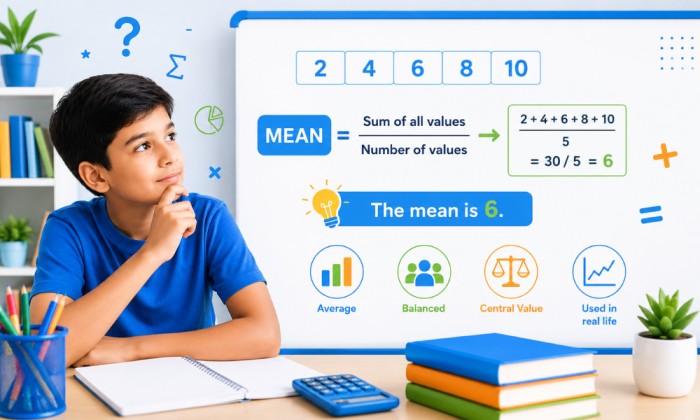
The mean in maths is the average of a set of numbers. To find it, add all the numbers together, then divide the total by how many numbers there are. For example, if a student scores 60, 70, and 80 in three tests, the mean score is (60 + 70 + 80) ÷ 3 = 70. It is one of the most important concepts in statistics and data, and Australian students begin working with it from around Year 5 and Year 6 under the Australian Curriculum.
Why the Mean Matters in Maths
The mean is not just a classroom exercise. It is a real-world tool used to summarise information quickly and fairly. Whether you are looking at test results, sports statistics, or household spending, the mean gives you a single number that represents a group of values.
In Australian schools, the mean sits within the Statistics strand of the Australian Curriculum. Students are expected to collect, display, and interpret data, and the mean is one of the key tools for doing that.
Where Students Use the Mean
- Calculating average test scores across a term
- Finding the average rainfall in a geography project
- Analysing sports performance data in PE
- Interpreting graphs and data sets in NAPLAN
How to Calculate the Mean: Step by Step
The process for finding the mean is straightforward and follows three simple steps.
Step 1: Add all the numbers together Step 2: Count how many numbers there are Step 3: Divide the total by the count
Worked Example
A student receives the following marks in five maths quizzes:
55, 60, 70, 75, 90
- Step 1: 55 + 60 + 70 + 75 + 90 = 350
- Step 2: There are 5 quiz scores
- Step 3: 350 ÷ 5 = 70
The mean score is 70.
This tells us that, on average, the student scored 70 out of 100 across all five quizzes.
Mean vs Median vs Mode: What Is the Difference?
Students often confuse the mean with two related concepts: the median and the mode. Together, these three are called measures of central tendency.
| Term | What It Means | Example (3, 5, 5, 7, 10) |
|---|---|---|
| Mean | The average | (3+5+5+7+10) ÷ 5 = 6 |
| Median | The middle value | 5 |
| Mode | The most common value | 5 |
When Is the Mean the Best Measure?
The mean works best when:
- The data set does not have extreme outliers (very high or very low values)
- All values in the set are roughly similar
- You need a precise average rather than a rough estimate
When a data set has outliers, the median can be a more reliable measure because it is not pulled up or down by extreme values.
Types of Mean in Maths
While the arithmetic mean is the one students learn first and use most often, there are other types of mean that appear in higher year levels.
Arithmetic Mean
The standard average. Add all values and divide by the count. Used from Year 5 upward.
Weighted Mean
Used when some values count more than others. Common in Year 11 and Year 12 when calculating assessment scores that carry different percentage weightings.
Geometric Mean
Used in more advanced maths and science to find the average of values that multiply together, such as growth rates. Appears in some HSC and VCE courses.
For most primary and junior secondary students in Australia, the arithmetic mean is the focus. Understanding it well builds the foundation for statistics in Year 9 NAPLAN, Year 10 data analysis, and beyond.
Common Mistakes Students Make with the Mean
Even when students understand the concept, small errors can lead to incorrect answers. Here are the most common ones to watch for:
- Forgetting to include all values when adding up the data set
- Dividing by the wrong number, for example dividing by the number of unique values instead of the total count
- Confusing the mean with the median, particularly when the data set is ordered
- Not checking for outliers that may skew the result
- Rounding too early in multi-step problems, which causes errors in the final answer
If your child is making these mistakes regularly, it may be a sign they need targeted support to strengthen their understanding of statistics and data interpretation.
How Mastering Maths Online Helps Students Understand the Mean
At Mastering Maths Online, our tutors work with Australian students from Year 1 through to Year 12. We follow the Australian Curriculum and tailor every session to what each student actually needs.
For students who are struggling with the mean and other statistics concepts, our tutors:
- Break down each step clearly using real examples
- Use Australian context (e.g., NAPLAN data, school results) to make concepts relatable
- Identify where gaps in understanding exist and address them directly
- Build confidence so students can apply skills independently in tests and exams
FAQs: What Does Mean Mean in Maths?
The mean is the average of a set of numbers. Add all the numbers together and divide by how many numbers there are.
Add up all the values in your data set, then divide the total by the number of values. For example, the mean of 4, 6, and 8 is (4 + 6 + 8) ÷ 3 = 6.
Australian students are typically introduced to the mean in Year 5 and Year 6 as part of the Statistics strand of the Australian Curriculum.
The mean is the average. The median is the middle value when numbers are ordered. The mode is the value that appears most often. All three are measures of central tendency.
The mean summarises a data set with a single number, making it easier to compare and interpret information. It is used in school assessments, science, economics, and everyday life.