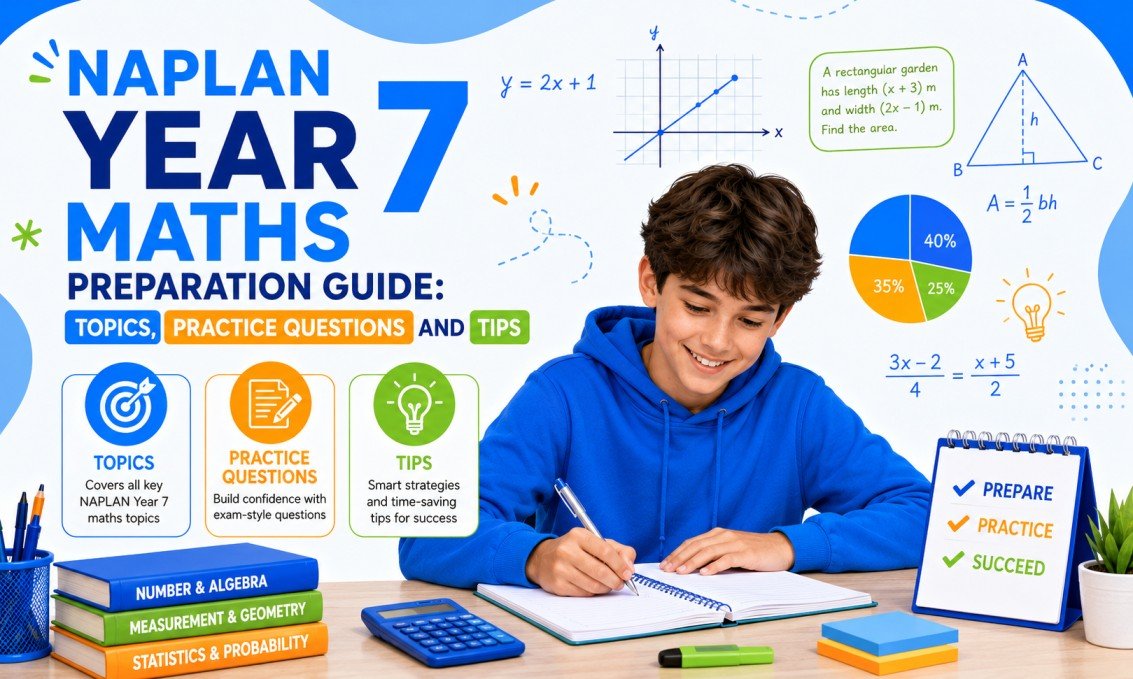

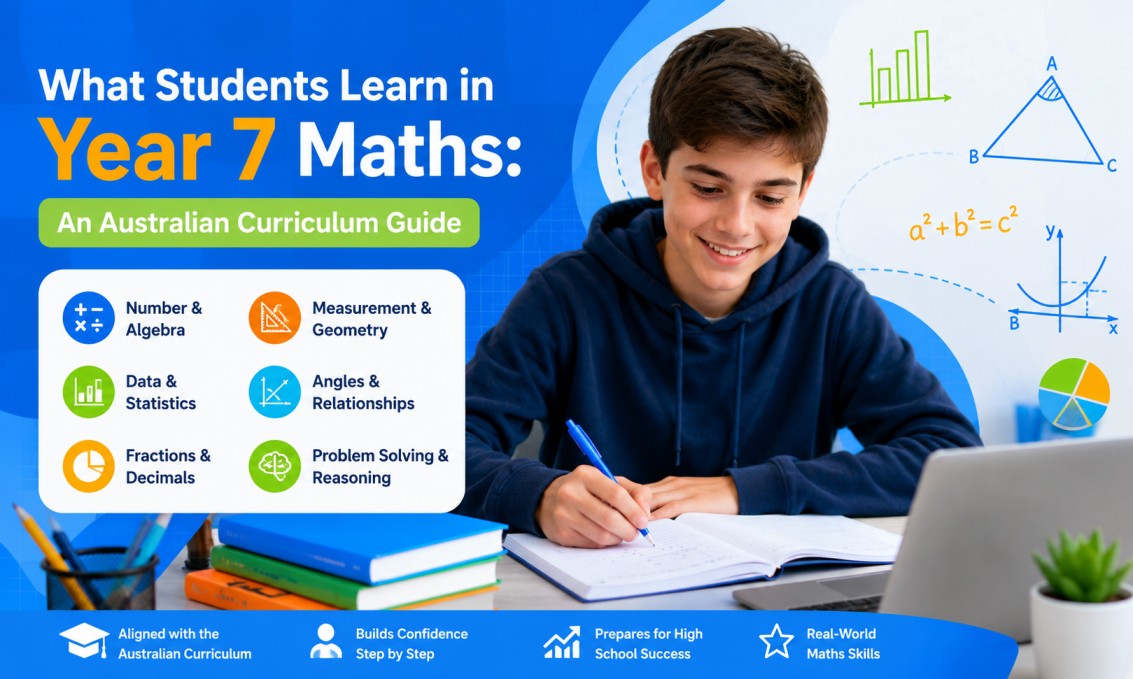
In Year 7, Australian students move from primary school arithmetic into the foundations of secondary mathematics, covering six curriculum strands under the Australian Curriculum v9.0: Number, Algebra, Measurement, Space, Statistics, and Probability. By the end of the year, most students are working with integers, fractions, decimals and percentages, writing and simplifying algebraic expressions, calculating area and volume, plotting points on the Cartesian plane, and interpreting real data sets.
This is one of the biggest step-ups in the entire schooling journey, and it catches many families off guard because the pace and abstraction increase quickly. This guide walks through exactly what is taught in each strand, why Year 7 matters so much for later success in Years 8 to 12, and practical ways to support your child if they start to fall behind.
Why Year 7 Maths Is a Turning Point
Year 7 is the first year of secondary school for most Australian students, and maths changes shape quickly. Concepts that were concrete in primary school, such as fractions and shapes, become more abstract and are combined with new ideas like negative numbers and algebra.
Teachers also expect greater independence. Students are asked to show working, justify their reasoning, and apply mathematical modelling to real world problems rather than just calculating an answer. Falling behind in Year 7 can compound quickly, since Year 8 and Year 9 build directly on these foundations.
The Six Strands of the Year 7 Curriculum
Under the Australian Curriculum v9.0, Year 7 maths is organised into six interrelated strands. Every Australian state and territory, including NSW, VIC, QLD, WA, SA, and TAS, follows this same structure, though some states use their own naming, such as the Victorian Curriculum 2.0.
Number
- Representing natural numbers in expanded form and as products of prime factors, using exponent notation
- Working with squares and square roots of perfect squares
- Adding and subtracting positive and negative integers
- Using all four operations with fractions and decimals, choosing efficient strategies
- Converting between fractions, decimals, and percentages, and applying them to real financial contexts such as discounts and simple interest
- Solving practical problems involving ratios and rates
Algebra
- Using algebraic expressions to represent everyday situations
- Describing relationships between variables using data
- Substituting values into simple formulas to find unknown quantities
- Solving simple linear equations
- Recognising and continuing number patterns and sequences
Measurement
- Calculating the area and perimeter of rectangles, triangles, and composite shapes
- Finding the volume and capacity of rectangular prisms
- Converting between metric units of length, area, and volume
- Working with time, including 24 hour time and timetables in real contexts
Space
- Classifying and constructing two dimensional shapes and three dimensional objects
- Identifying and using angle relationships, including angles on a straight line and at a point
- Plotting and interpreting points on the Cartesian plane using all four quadrants
- Describing transformations such as reflections, rotations, and translations
Statistics
- Collecting, organising, and displaying data using tables and graphs
- Calculating measures of centre, including the mean and median
- Interpreting data critically, including identifying misleading graphs
- Comparing data sets to draw simple conclusions
Probability
- Describing probabilities using fractions, decimals, and percentages
- Conducting simple chance experiments and comparing observed results to expected outcomes
- Identifying and listing outcomes of simple events, including using tables
Topics Most Year 7 Students Find Difficult
Not every topic lands the same way. Based on the areas tutors are asked to help with most often, a handful of topics consistently trip students up in the first year of secondary maths.
- Negative numbers, particularly subtracting a negative or multiplying two negatives
- Algebra, especially the shift from arithmetic to using letters as unknown values
- Fraction and percentage conversions applied to real world money problems
- Multi step area and volume problems involving composite shapes
- Reading and interpreting the Cartesian plane across all four quadrants
How Year 7 Maths Connects to Later Success
Year 7 is not an isolated year. The number and algebra skills developed here are the direct building blocks for linear equations in Year 8, indices and surds in Year 9, and the trigonometry and quadratic functions that appear from Year 10 onwards.
Students who master negative numbers, fractions, and basic algebraic manipulation in Year 7 generally find Years 8 and 9 far more manageable. Students who develop gaps in Year 7, particularly around algebra, often carry that uncertainty right through to their HSC, VCE, QCE, WACE, or SACE studies unless it is addressed early.
How to Support Your Child at Home
You do not need to be a maths expert to help your Year 7 student stay on track. A few consistent habits make a real difference.
- Ask your child to explain a problem out loud rather than just checking the final answer, since explaining reveals gaps in understanding
- Connect percentages and ratios to everyday situations, such as sale discounts, recipes, or sports statistics
- Encourage neat, step by step working, which matters more in Year 7 than it did in primary school
- Keep an eye on NAPLAN results and school reports for early signs of a specific strand, such as algebra or measurement, becoming a pattern of difficulty
- Bring in a qualified tutor early if a topic is not clicking, rather than waiting for results to slip across a full term
Conclusion
Year 7 maths covers real ground, moving students from primary arithmetic into the number, algebra, measurement, space, statistics, and probability skills that carry them through the rest of secondary school. The strands are consistent across every Australian state and territory, though the pace can feel sudden compared to primary school.
At Mastering Maths Online, our tutors work one-on-one with students across Australia, aligned to the Australian Curriculum v9.0, to build confidence in exactly the areas where a student needs it most, whether that is negative numbers, algebra, or reading the Cartesian plane.
Frequently Asked Questions
Algebra and negative numbers are usually the hardest for Year 7 students, since both require abstract thinking that goes beyond the concrete arithmetic learned in primary school.
The core content is consistent nationally under the Australian Curriculum v9.0, though some states use their own version, such as the Victorian Curriculum 2.0, with the same underlying strands.
This varies by school, but most Year 7 students benefit from at least twenty to thirty minutes of regular practice several times a week, on top of set homework.
Yes. Year 7 NAPLAN numeracy testing covers many of the same strands taught in class, so strong classroom understanding directly supports NAPLAN performance.
As soon as a specific topic, such as algebra or fractions, is consistently causing frustration or falling test scores, since early support prevents small gaps from becoming bigger ones in Year 8 and beyond.