
Introduction
Starting Year 7 is a big moment for Australian students. After six or seven years of primary school maths, they walk into high school and quickly discover that the subject feels different. The topics are more abstract, the pace picks up, and the expectations around independent thinking are noticeably higher. Many students who coasted through primary school suddenly find themselves struggling, not because they are not capable, but because nobody told them what was coming. This guide explains exactly what changes in Year 7 maths, why those changes catch students off guard, and what parents can do right now to help their child adapt confidently.
| Key takeaway: The jump from primary to high school maths is real, but it is manageable with the right preparation and support. |
What Actually Changes in Year 7 Maths?
The shift is not just about harder content. It is about how maths is taught and how students are expected to think.
1. Abstract Concepts Replace Concrete Ones
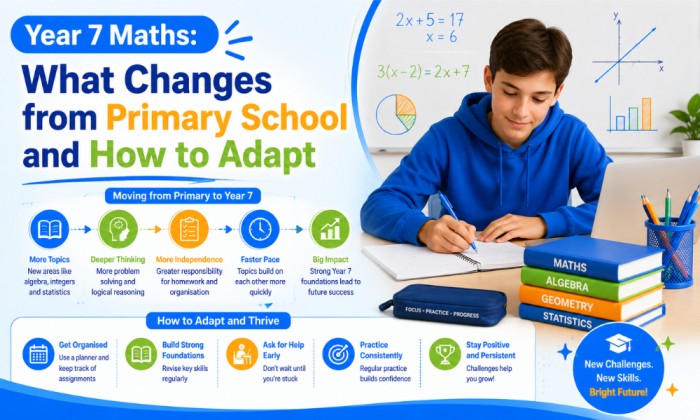
In primary school, maths is largely hands-on and visual. Students count objects, use number lines, and work with shapes they can see and touch. In Year 7, the curriculum moves into algebra, which asks students to think in symbols and variables rather than concrete numbers.
For example, instead of solving “what is 3 plus 5?”, a Year 7 student might be asked to solve “if 3x + 5 = 20, find x”. This requires a completely different type of reasoning.
2. The Pace Is Faster
Primary school teachers often revisit concepts multiple times over weeks or months. High school moves quickly. A Year 7 class might cover a new topic every one to two weeks. Students who miss a foundational idea can fall behind fast because each new topic often builds directly on the last.
3. Less Teacher-Led Support
Primary school teachers tend to check in with students frequently throughout a lesson. In high school, students are expected to take more ownership of their learning. If a student does not understand something, they need to actively seek help rather than wait for a teacher to notice.
4. New Topics Are Introduced
Year 7 introduces several concepts that students have not encountered before, including:
- Algebra and the use of pronumerals
- Negative numbers and the number line extended below zero
- Ratios and proportional reasoning
- Basic probability and data representation
- Introduction to Cartesian coordinates and graphing
These are not extensions of primary topics. They are genuinely new areas of mathematics that require fresh thinking.
Why Some Students Struggle in Year 7
The gap between primary and high school maths is not talked about enough. Here are the most common reasons students find Year 7 difficult.
Gaps in Primary School Foundations
Algebra in Year 7 relies heavily on a solid understanding of arithmetic. Students who are shaky on fractions, multiplication, division, or working with negative numbers will find algebra particularly challenging. These foundational gaps often go undetected in primary school because the content is simpler overall.
Overconfidence After Primary School
Students who did well in primary school maths sometimes assume high school will be just as straightforward. When the difficulty ramps up, they are caught off guard and may not know how to ask for help or adjust their study habits.
Study Skills Have Not Developed Yet
Primary school students rarely need to study maths at home. High school maths often requires regular practice outside the classroom. Students who have never built that habit need to develop it quickly in Year 7.
| Did you know? Research consistently shows that students who practise maths for even 20 minutes a day outside school hours perform significantly better than those who rely on classroom time alone. |
How to Help Your Child Adapt
The good news is that the transition does not have to be stressful. There are practical steps parents can take from the very beginning of the school year.
Address Foundation Gaps Early
Before Year 7 starts or in the first few weeks, check whether your child is confident with fractions, decimals, percentages, and basic operations. If they are not, this is the time to address those gaps rather than waiting until algebra becomes confusing.
Build a Regular Maths Routine
Encourage your child to spend 20 to 30 minutes on maths every day or every second day, not just before tests. Consistency matters far more than cramming. Even revisiting the day’s class notes and attempting a few practice questions is enough to reinforce learning.
Teach Them to Ask for Help
Many Year 7 students feel embarrassed to ask their teacher for help in front of the class. Talk to your child about using lunch breaks, staying after class, or reaching out to their teacher by email. Normalise asking questions as a sign of confidence, not weakness.
Consider Targeted Maths Tutoring
If your child is showing signs of frustration or falling behind, early intervention is far more effective than waiting. A good Year 7 maths tutor can identify exactly where the gaps are and work on them in a way that suits your child’s pace and learning style.
At Mastering Maths Online, we work with Year 7 students across Australia to build confidence, close foundation gaps, and develop the independent thinking skills that high school maths demands.
Signs Your Year 7 Child May Need Extra Support
Watch for these early warning signs:
- They are consistently bringing home low quiz or test results
- They say they “do not get” algebra after the first few weeks
- They are avoiding maths homework or making excuses not to do it
- They seem anxious or upset before maths class or tests
- Their primary school results were strong, but high school results are declining
One or two of these signs does not mean there is a crisis. But several appearing together is a signal worth acting on promptly.
Conclusion
Year 7 maths represents a genuine shift in how students learn and think about mathematics. The change from concrete primary school topics to abstract high school concepts is significant, but it is absolutely manageable with the right support in place. The students who adapt well are not necessarily the smartest ones. They are the ones whose parents paid attention early, built good habits quickly, and did not wait until the first exam to seek help.
If your child is entering Year 7 or has already started and is finding it tough, reach out to us at Mastering Maths Online. Our experienced tutors are here to help Australian students build the skills and confidence they need to thrive in high school maths and beyond.
Frequently Asked Questions
Yes, this is very common. The jump from primary to high school maths involves new ways of thinking, not just harder arithmetic. Many strong primary students find Year 7 challenging at first. Early support makes a significant difference.
Year 7 covers algebra, integers and negative numbers, fractions and decimals, ratios, basic probability, data and statistics, geometry, and an introduction to graphing. The exact sequence varies by state and school, but these are the core areas across the Australian Curriculum.
Aim for 20 to 30 minutes of focused maths practice most days. Short and consistent sessions are more effective than occasional long study blocks. Reviewing class notes and attempting a few problems each day is a great starting point.
Yes. Online tutoring is highly effective for Year 7 students, particularly when sessions are personalised and consistent. It also removes the anxiety some students feel in a classroom setting, making it easier for them to ask questions and work at their own pace.