
NAPLAN Numeracy is designed to assess how students apply mathematics knowledge, skills, procedures and processes in different contexts. The assessment is aligned with the Australian Curriculum.
Year 5 students may encounter questions involving:
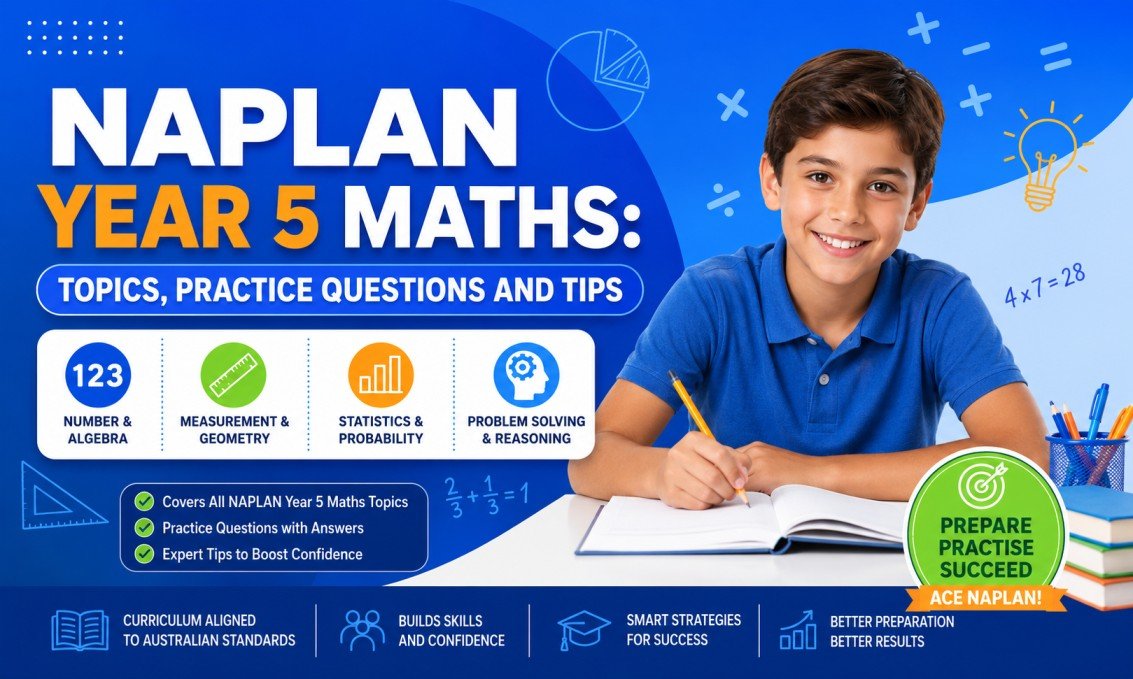
- Number and algebra
- Measurement and geometry
- Statistics and probability
- Mathematical reasoning
- Problem solving
- Interpreting tables, graphs, diagrams and other representations
NAPLAN is not a pass or fail test. Student performance is reported across four proficiency levels: Exceeding, Strong, Developing and Needs additional support.
The assessment is one source of information about a student’s learning. It should be considered alongside classroom assessment, teacher feedback and other evidence of progress.
NAPLAN Year 5 Maths Topics
Understanding the major content areas gives students a useful starting point for preparation.
1. Number and Algebra
Number and algebra form a major part of Year 5 Numeracy. Students need to be comfortable working with whole numbers, fractions, decimals, operations and patterns.
Important skills include:
- Reading, comparing and ordering numbers
- Addition and subtraction
- Multiplication and division
- Multiplication facts
- Fractions and equivalent fractions
- Decimals, including tenths
- Number patterns
- Number sentences
- Unknown values
- Odd and even numbers
- Using mathematical relationships to solve problems
Students should also understand which operation is appropriate for a particular problem.
For example, a question may describe a real life situation rather than simply asking students to calculate 36 × 4. The student must first understand what the question is asking and then select the correct operation.
2. Measurement
Measurement questions can involve everyday situations and require students to select appropriate units or calculate measurements.
Students should practise:
- Length
- Mass
- Capacity
- Area
- Perimeter
- Time
- Duration
- Metric units
- Reading scales
- Converting between common units
Students should know when to use units such as millimetres, centimetres, metres, grams, kilograms, millilitres and litres.
Time is also important. Students should be able to read analogue and digital clocks, compare times and calculate elapsed time.
3. Geometry and Space
Geometry questions test how well students understand shapes, angles, position and movement.
Key areas include:
- 2D shapes
- 3D objects
- Properties of shapes
- Angles
- Symmetry
- Maps
- Grid references
- Directions
- Position and movement
- Pathways
- Representations of 3D objects
Students should become familiar with mathematical language such as parallel, perpendicular, symmetry, angle, vertex and face.
NAPLAN proficiency descriptions show that stronger Year 5 students may be expected to interpret angles, describe pathways, identify lines of symmetry and interpret 2D representations of 3D objects.
4. Statistics and Data
Year 5 students need to understand how information is represented and how to use data to answer questions.
Common areas include:
- Tables
- Tally charts
- Column graphs
- Picture graphs
- Two way tables
- Comparing data
- Finding patterns in data
- Making predictions
- Checking statements against data
A question may provide a graph and ask students to determine which statement is correct. The challenge is often understanding the information before performing any calculation.
5. Chance and Probability
Chance questions focus on the likelihood of different outcomes.
Students should understand terms such as:
- Certain
- Likely
- Unlikely
- Impossible
- Equally likely
They may need to compare events or determine the possible outcomes of a simple chance experiment.
6. Problem Solving and Reasoning
NAPLAN Numeracy is not only about performing calculations. Students also need to apply mathematics to problems and explain or identify appropriate reasoning.
A student may need to:
- Identify relevant information
- Decide which operation to use
- Interpret a diagram
- Recognise a pattern
- Compare different possibilities
- Work through more than one step
- Check whether an answer makes sense
The current NAPLAN assessment framework places emphasis on fluency, understanding, problem solving and reasoning.
NAPLAN Year 5 Maths Practice Questions
The following questions are original practice examples designed to develop skills relevant to Year 5 Numeracy.
Question 1: Multiplication
A school has 24 boxes. Each box contains 18 pencils.
How many pencils are there altogether?
Answer: 432 pencils
24 × 18 = 432
Question 2: Fractions
A cake is divided into 8 equal pieces. Mia eats 3 pieces.
What fraction of the cake is left?
Answer: 5/8
There are 8 pieces altogether and 3 have been eaten.
8 − 3 = 5
Question 3: Decimals
Which number is greater?
0.6 or 0.56
Answer: 0.6
0.6 can be written as 0.60, which is greater than 0.56.
Question 4: Time
A swimming lesson begins at 3:25 pm and finishes at 4:10 pm.
How long does the lesson last?
Answer: 45 minutes
From 3:25 pm to 4:00 pm is 35 minutes.
From 4:00 pm to 4:10 pm is 10 minutes.
35 + 10 = 45 minutes.
Question 5: Measurement
A rectangular garden is 8 metres long and 5 metres wide.
What is its perimeter?
Answer: 26 metres
8 + 5 + 8 + 5 = 26 metres.
Question 6: Data
A class records the number of books read by four students:
| Student | Books |
|---|---|
| Jack | 6 |
| Mia | 9 |
| Noah | 4 |
| Ava | 7 |
Who read the most books?
Answer: Mia
Mia read 9 books.
Question 7: Number Pattern
Look at the pattern:
5, 10, 20, 40, ___
What number comes next?
Answer: 80
Each number is multiplied by 2.
Question 8: Probability
A bag contains 8 red counters and 2 blue counters.
Which colour is more likely to be selected?
Answer: Red
There are more red counters than blue counters.
How to Prepare for NAPLAN Year 5 Maths
Effective preparation should focus on understanding rather than simply completing questions quickly.
Review Core Maths Skills
Start with the areas your child finds difficult.
Review:
- Multiplication and division facts
- Fractions
- Decimals
- Measurement
- Time
- Geometry
- Data
- Probability
- Number patterns
- Word problems
A short diagnostic quiz can help identify gaps before creating a study plan.
Practise Word Problems
Many students can perform calculations but struggle when mathematics is presented as a written problem.
Encourage your child to ask:
- What information is given?
- What do I need to find?
- Which operation should I use?
- Is there more than one step?
- Does my answer make sense?
This approach helps students become more independent problem solvers.
Practise Different Question Formats
NAPLAN Numeracy can include multiple choice, text entry and technology enhanced questions such as drag and drop and hot spot questions.
Students should therefore practise more than traditional worksheet questions.
The official NAPLAN public demonstration site is useful for familiarising students with question types and online features.
Build Mental Maths Skills
Encourage students to calculate simple problems mentally before reaching for a written method.
Useful skills include:
- Multiplication facts
- Division facts
- Number bonds
- Place value
- Estimation
- Mental addition
- Mental subtraction
- Fraction relationships
Strong mental maths skills can help students work more efficiently.
Teach Students to Check Their Answers
An incorrect answer is not always caused by a lack of mathematical knowledge.
Students can make mistakes because they:
- Read the question too quickly
- Choose the wrong operation
- Misread a graph
- Forget a unit
- Make a calculation error
- Miss an important piece of information
Teach your child to pause and check whether the answer is reasonable.
NAPLAN Year 5 Maths Tips for Students
Read Every Question Carefully
Do not rush to calculate. First understand what the question is asking.
Look at Units
Pay attention to words such as metres, centimetres, kilograms, litres, dollars and minutes.
Use Estimation
If the exact answer is not obvious, estimate first. This can help identify an unreasonable answer.
Draw a Diagram
For geometry, measurement and some word problems, a simple drawing can make the problem easier to understand.
Look for Patterns
When numbers repeat or change in a particular way, look for the mathematical rule before selecting an answer.
Do Not Spend Too Long on One Question
If a question is difficult, use the available information and your best strategy. Avoid allowing one question to affect your confidence with the rest of the assessment.
How Parents Can Support Year 5 NAPLAN Maths Preparation
Parents do not need to turn home study into a second classroom.
Small, regular practice sessions can be more useful than long study sessions.
Try using everyday activities such as:
- Comparing prices while shopping
- Calculating change
- Reading timetables
- Measuring ingredients
- Comparing distances
- Looking at sports statistics
- Reading charts and graphs
- Estimating quantities
These activities show children that mathematics is useful outside school.
If your child repeatedly struggles with the same concept, targeted support can be more effective than simply giving them additional worksheets.
One to one online maths tutoring can provide personalised explanations, guided practice and feedback based on the student’s individual needs.
How Online Maths Tutoring Can Help With NAPLAN
Online maths tutoring can help Year 5 maths students strengthen specific areas before NAPLAN.
A structured tutoring program may include:
- An initial skills assessment
- Identification of learning gaps
- Australian Curriculum aligned lessons
- NAPLAN style practice questions
- Problem solving activities
- Reasoning practice
- Regular progress checks
- Personalised feedback
At Mastering Math Online, online lessons can give students an opportunity to ask questions, work through problems step by step and develop greater confidence with mathematics.
The goal should not be to teach children to memorise answers. It should be to help them understand mathematical concepts and apply them confidently.
When Should Year 5 Students Start NAPLAN Maths Preparation?
There is no need for intensive preparation many months before the assessment.
A better approach is to build mathematical skills throughout the school year and introduce focused NAPLAN practice closer to the assessment period.
A simple preparation approach could be:
Several months before NAPLAN:
Focus on core Year 5 mathematics and identify learning gaps.
Several weeks before NAPLAN:
Introduce timed practice and a wider range of problem solving questions.
The week before NAPLAN:
Review key skills, practise question formats and focus on confidence.
The day before NAPLAN:
Avoid heavy study. Encourage normal routines, adequate sleep and a positive mindset.
What Makes a Strong NAPLAN Year 5 Maths Student?
A strong student is not necessarily the one who completes every calculation the fastest.
Successful Year 5 students can:
- Understand mathematical language
- Apply known skills to new situations
- Choose appropriate strategies
- Interpret tables and graphs
- Work confidently with numbers
- Recognise patterns
- Use estimation
- Solve multi step problems
- Explain their mathematical thinking
- Check whether an answer is reasonable
According to the official Year 5 proficiency descriptions, students performing at higher levels may need to solve multi step problems, work with fractions and decimals, calculate area and perimeter, interpret timetables, analyse data and reason about angles, symmetry and probability.
Conclusion
NAPLAN Year 5 Maths is designed to measure how students apply mathematics rather than simply how well they memorise procedures. The most important preparation areas include number and algebra, measurement, geometry, statistics, probability, problem solving and mathematical reasoning. Regular practice with different question types can help students identify gaps, improve accuracy and build confidence. Parents can support preparation through everyday maths activities, while targeted online tutoring can provide additional guidance when a child needs more personalised support. With consistent practice and a calm approach, Year 5 students can enter NAPLAN feeling better prepared to demonstrate what they know.
Frequently Asked Questions
Year 5 Numeracy covers number and algebra, measurement and geometry, statistics and probability, along with mathematical problem solving and reasoning.
The difficulty varies between questions and students. NAPLAN includes questions designed to assess a range of skills and levels of mathematical proficiency.
Use curriculum based maths questions, word problems, data interpretation, mental maths activities and official NAPLAN sample resources.
Yes. Personalised tutoring can identify specific learning gaps and provide targeted practice in areas such as fractions, decimals, measurement, problem solving and reasoning.
NAPLAN is held nationally in March. The exact dates vary by year. The 2026 test window was 11 to 23 March.