
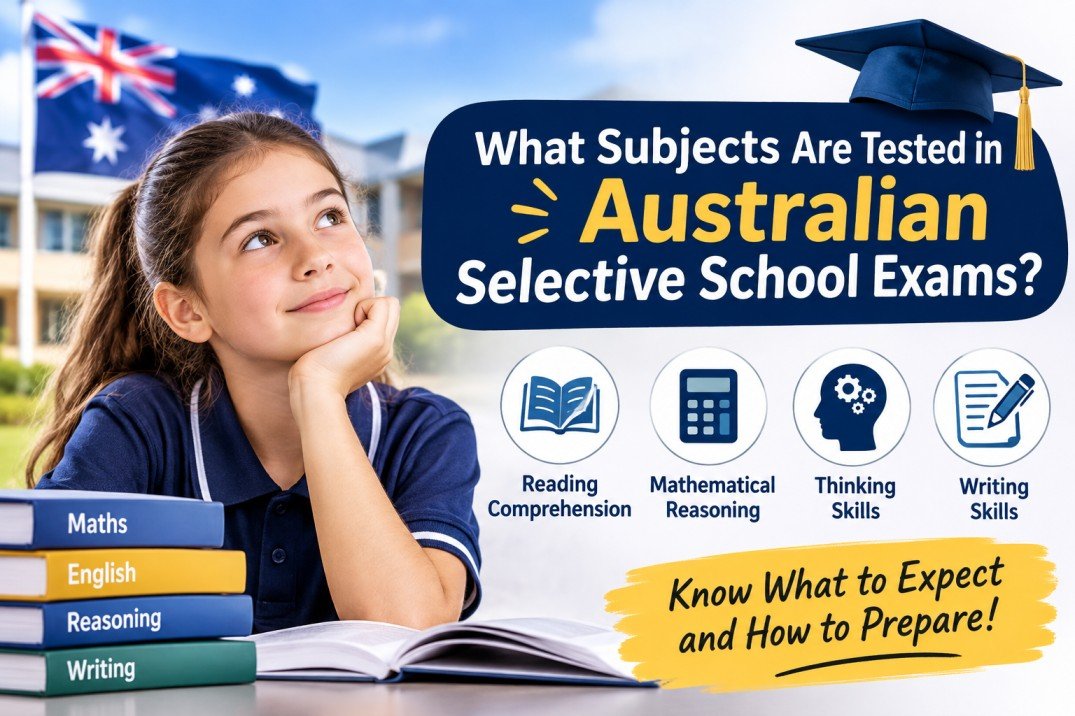
The Australian selective school exam does not test school subjects such as science, history or geography. In NSW, the Selective High School Placement Test assesses four areas: Reading, Mathematical Reasoning, Thinking Skills and Writing. Other states use different tests, such as Victoria’s ACER exam and Western Australia’s ASET, but they also assess reading, maths or quantitative reasoning, abstract or verbal reasoning, and writing. The focus is reasoning and comprehension, not memorised facts.
Which Tests Count as Selective School Exams in Australia?
Australia does not have a single national selective exam. Each state or school system runs its own process, so the first step is to know which test applies to your child. The table summarises the main tests. Formats change over time, so confirm current details with the relevant authority.
| Test | Who sits it | What is tested |
| NSW Selective High School Placement Test | Year 6, for Year 7 entry | Reading, Mathematical Reasoning, Thinking Skills and Writing. Each section is weighted equally. |
| NSW Opportunity Class Placement Test | Year 4, for Year 5 entry | Reading, Mathematical Reasoning and Thinking Skills. There is no Writing section. |
| Victorian Selective Entry High Schools exam | Year 8, for Year 9 entry | An ACER exam covering reading comprehension, mathematics, verbal and quantitative reasoning, and writing. |
| WA Academic Selective Entrance Test (ASET) | Year 6, for Year 7 entry to Perth Modern School and GATE programs | Reading, writing, quantitative reasoning and abstract reasoning. |
| Queensland, South Australia, Tasmania and the ACT | Varies | Selection methods differ by school or program. Some use ACER or EduTest style tests, so check each school directly. |
Because NSW has the largest selective system and the most published information, the rest of this guide uses the NSW Selective High School Placement Test as the main example, then summarises the other states.
What Subjects Are Tested in the NSW Selective High School Placement Test?
The NSW Department of Education describes the test as a way for students to show their reading, reasoning, thinking and writing ability, and says students do not need to learn or memorise facts about specific subjects. The test is computer based and has four equally weighted sections.
| Section | Time | Questions | Format |
| Reading | 45 minutes | About 17 | Multiple choice, with some multi part questions |
| Mathematical Reasoning | 40 minutes | 35 | Multiple choice, no calculator |
| Thinking Skills | 40 minutes | 40 | Multiple choice |
| Writing | 30 minutes | 1 task | One typed written response |
Reading
Reading tests comprehension, inference and the ability to interpret meaning and tone across fiction, nonfiction and poetry. Questions often ask what a writer implies rather than what is stated directly. This is the closest section to a school English subject, but it rewards careful, flexible reading rather than knowledge of particular books.
Mathematical Reasoning
Mathematical Reasoning is the section most closely linked to school maths, but it is not a content test. The ideas come from number, patterns and algebra, measurement and geometry, and data and probability that students meet in primary school. The challenge is applying them to unfamiliar problems, often inside a short story, without a calculator and with roughly a minute per question.
Thinking Skills
Thinking Skills needs no subject knowledge. It combines verbal reasoning, such as logic puzzles and analysing arguments, with non verbal reasoning, such as pattern sequences and figure matrices. Because these question types rarely appear in everyday classwork, many strong students need practice with the format.
Writing
Students type one response to a set prompt in 30 minutes. Markers look at how well ideas are chosen, developed and organised, and how clearly they are communicated. The Department states that writing must address the given topic, otherwise it is marked lower regardless of fluency or creativity. Reading the prompt carefully is therefore part of the skill.
What is not tested
The NSW test does not include science, history, geography or general knowledge, and it does not test spelling lists or memorised facts. This is why preparing by reading widely, practising reasoning and writing under time limits is more useful than trying to cover extra school topics.
How Do the Tested Skills Connect to What Your Child Already Learns?
| Tested area | Related school learning | How to build the skill at home |
| Reading | English comprehension and wide reading | Read varied texts and discuss what the author implies, not just what happens. |
| Mathematical or quantitative reasoning | Primary maths: fractions, ratio, patterns, area, data | Practise word problems without a calculator and explain each step aloud. |
| Thinking Skills, verbal and abstract reasoning | Little direct classroom coverage | Try logic puzzles, pattern sequences and short timed practice sets. |
| Writing | English writing tasks | Practise planning for two minutes, then writing a structured response to a prompt. |
For maths specifically, secure Year 5 and Year 6 number skills make the reasoning questions much easier. Parents who want to build that foundation can look at our Year 6 maths tutoring and Year 5 maths tutoring pages, or read our advice on building your child’s maths confidence at home.
When Is the Next NSW Selective Test?
The NSW Department of Education has published the following dates for Year 7 entry in 2028. Dates can change, so always check the Department’s application page.
| Activity | Date |
| Applications open | 5 November 2026 |
| Applications close | 15 February 2027. No late applications are accepted. |
| Selective High School Placement Test | 13 and 14 May 2027. Each student is allocated one test day. |
| Make up test | 11 June 2027 |
| Opportunity Class Placement Test (Year 5 entry in 2028) | 11 and 12 May 2027, with a make up test on 10 June 2027 |
How Can a Maths Tutor Help With Selective School Preparation?
A tutor can help students practise the unfamiliar question styles, build speed without a calculator and learn to explain their reasoning clearly. At Mastering Math Online, our selective school maths tutoring is delivered one on one and starts from the student’s current understanding, so practice targets the reasoning skills the test actually rewards. Families who want a first look at what a lesson involves can book a free trial.
Frequently Asked Questions
Is the selective school exam the same in every state?
No. NSW, Victoria and Western Australia each use a different test, and other states leave selection to individual schools. The tests share a similar shape, with reading, maths or quantitative reasoning, a reasoning section and often writing, but timing, year level and question style differ.
Are science or general knowledge tested?
No. The NSW test does not require students to learn facts about specific subjects, and the other tests described here focus on reasoning, comprehension and writing rather than subject content.
Is a calculator allowed?
Calculators are not permitted in the NSW Mathematical Reasoning section. Check the instructions for any other test your child sits.
Which maths topics should my child revise?
Focus on primary school number skills: fractions, decimals, percentages, ratio, patterns, area, perimeter, angles and reading graphs. Then practise using them in unfamiliar word problems.
How early should we start preparing?
There is no official starting point. Many tutors suggest short, regular practice over several months rather than a rushed final push, but the Department’s guidance is that only a small amount of preparation is needed. Match the effort to your child’s confidence and the test date.